- Home
- How to Learn Figure Drawing
- Line of Action
Video: The Line of Action
One of the essential first lines of a figure drawing
The
line of action is one of the first — and most important — elements of every
strong figure drawing. In this video lesson from Figure Drawing
Quickstart, you'll learn what this line is, how to find it in
any pose, and why I teach it differently from many figure drawing resources.
Identifying and drawing the main action line is a skill from Phase 1 of learning how to draw the figure.
Discover how to learn figure drawing in 4 phases here: The Figure Drawing Learning Path.
Watch the video below:
Prefer to read? The article version is below:
What is the Line of Action in Figure Drawing?
One
of the most important gesture lines we draw in a figure drawing is the Line of
Action – also called a Main Action Line, or Line of Major Action.
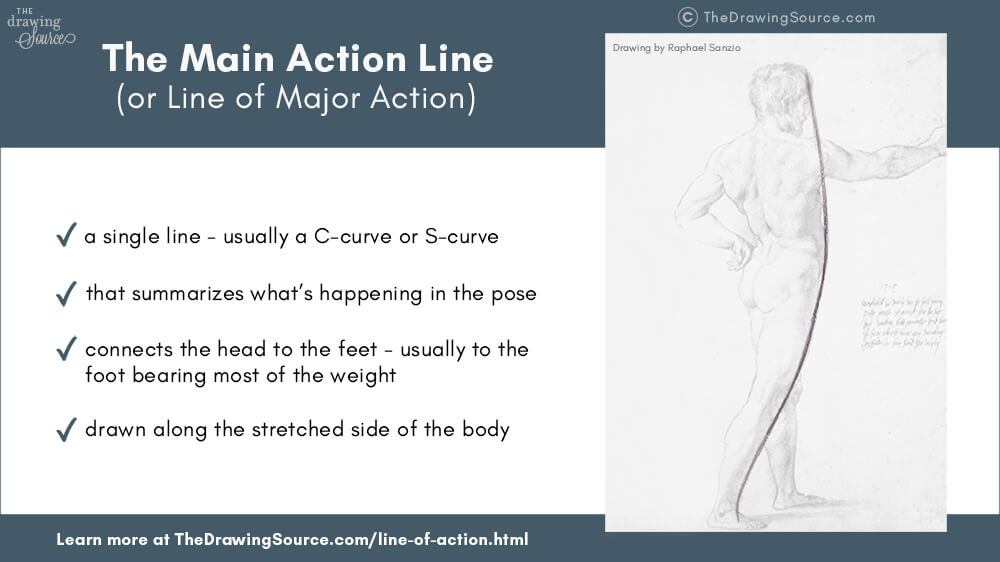
The main action line is a single line, usually a C-Curve or S-Curve. It summarizes what’s happening in the pose, and it connects the head to the feet (usually, though not always, to the foot bearing most of the figure’s weight).
Because it connects the head to the feet, it also establishes the height of your drawing.
Finally, we are going to draw the main action line along the stretched or extended side of the body. (I’ll show you what that means in a moment, and explain why I don’t teach you to draw it along the center line, as many people do.)
For
a single line, the main action line really does quite a lot.
If
you’re wondering: can we really communicate all of this … in a single line?
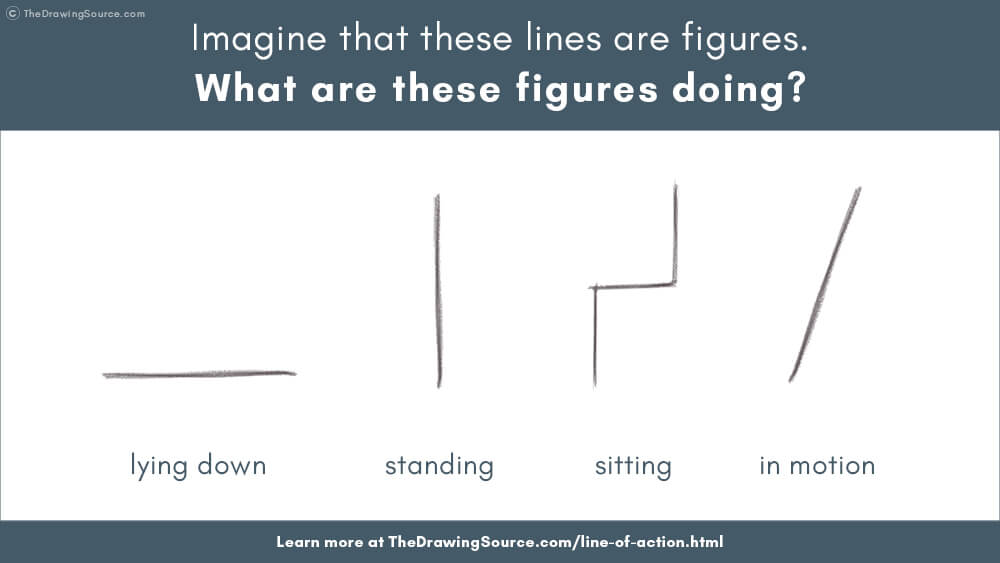
Take a look at the lines below. Imagine that they're figures. If I asked you, “What are these figures doing?” – what would you say?
Probably lying down, standing, sitting, and in some sort of motion, right?
Lines
are very descriptive and expressive.
How to find the Line of Action of a pose
➤ 1. To find the line of action of a
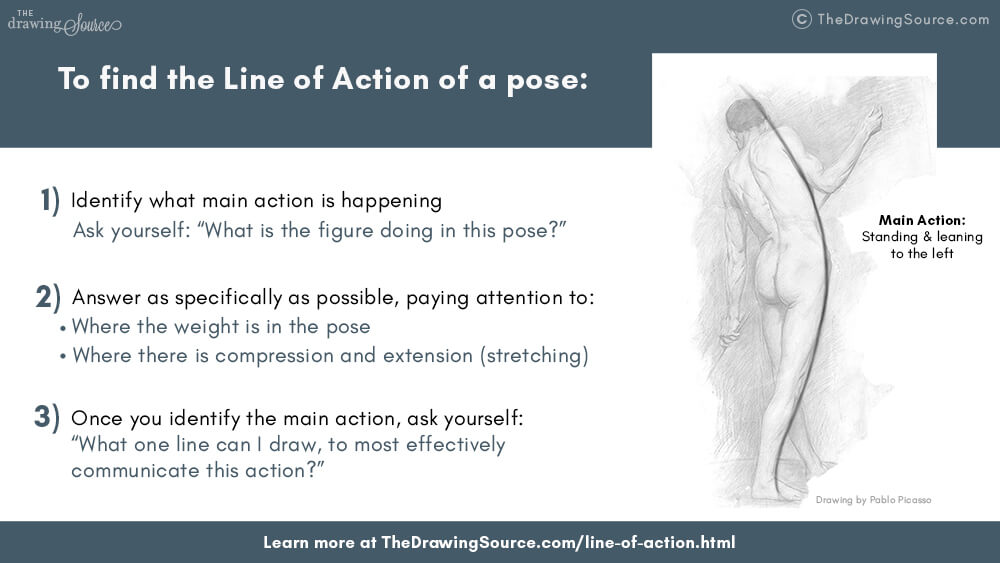
pose, we first need to identify what main action is happening.
We can do this by asking ourselves: “What is the figure
doing in this pose?”
We should start every figure drawing by asking ourselves this question.
When you answer it, be as specific as you can in your description, paying close attention to where the weight is in the pose, and where there is compression or extension happening in the body.
For example, this figure is standing with weight distributed on both feet.
He’s
leaning to the left and holding a pole, which he may be leaning on slightly. The
left arm is extended down and the right arm is bent at the elbow.
➤ 2. If
you can, stand up for a moment and put yourself into this pose.
Where
do you feel a stretch and where do you feel compression?
The
stretch is along the right side of the body and the left side is compressed, or
pinched. Great.
➤ 3. Next: What is the main action of the pose?
I
would say: standing and leaning to the left.
➤ 4. Once
you’ve identified the main action of the pose, ask yourself:
What one line can
I draw to illustrate this action? What line is essential to this pose?
That will be your main action line.
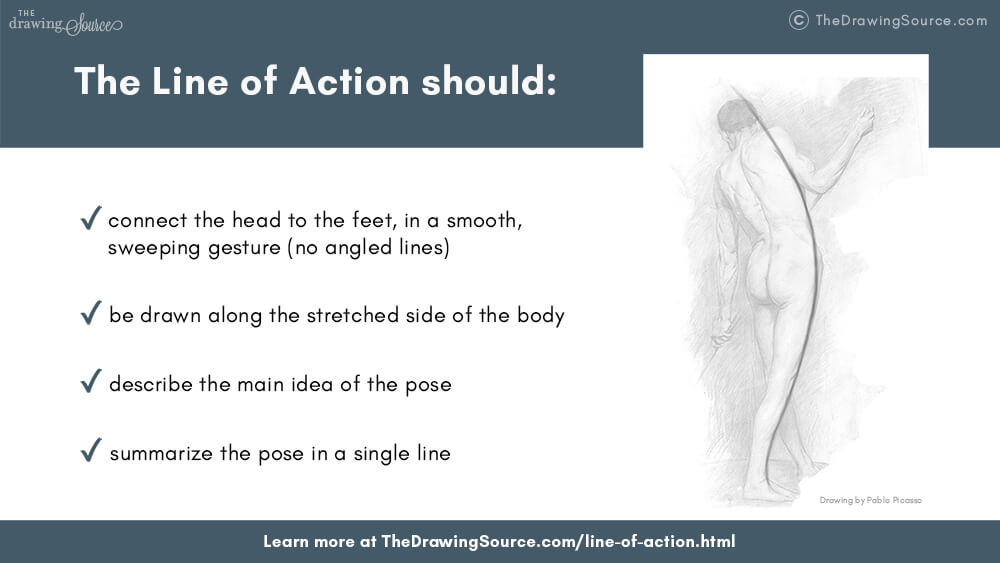
I
would draw it like this:
Remember
that it should connect the head to the feet in a smooth, sweeping gesture. And
we want to draw it along the stretched side of the body.
I chose to extend the main action line to the right foot because I think there might be a bit more weight there, and it creates a simpler curve when I draw the line from the head to the right foot rather than the left foot.
This
is our goal with the line of action:
To describe the main idea of the pose.
To summarize the pose in a single line.
Why draw the line of action along the stretched side of the body
instead of the center line?
Many figure drawing resources teach the line of action as a line running
through the center of the figure.
This is certainly not wrong — there are many valid approaches to figure drawing.
Having said that: While the center can capture the general movement of a pose and is an important line, for the main action line I find it less useful. Here's why:
In most poses, the body has two contrasting sides: one that is
stretched or extended, and one that is compressed. This contrast is what
creates the sense of movement and life in a figure drawing:
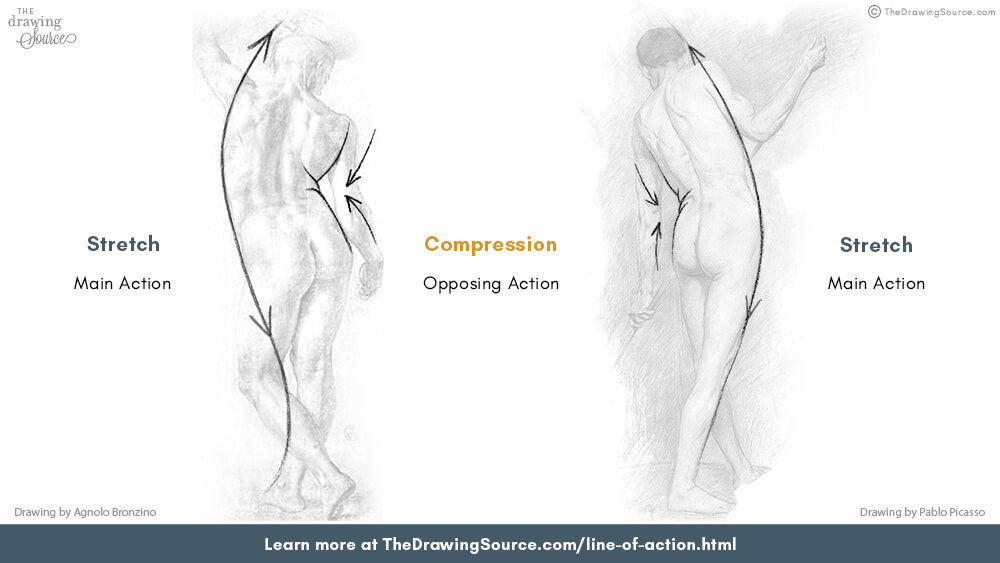
When we draw the line of action along the stretched side, we're
capturing the longest line of the pose. Additionally, it sets us up for the next step:
identifying and drawing the opposing, compressed action on the other side of the
body.
These two lines — the stretched action and the compressed action — work together to describe the full movement of the pose. Drawing the center line gives you neither clearly.
This is why, in the 7-step Figure Drawing Framework, which you can learn
in Figure Drawing Quickstart, the line of action is one of the first elements
we establish — and why drawing it specifically along the extended or stretched side of the
body gives you a more useful foundation for everything that follows.
Line of Action: Example 2
Let's look at one more example. Where do we draw the line of action on this beautiful drawing by Herbert Draper?
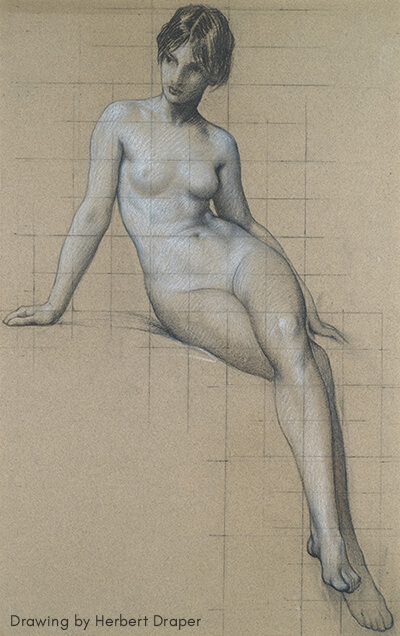
What is the figure doing?
She’s seated with her legs crossed. She is slightly leaning on her right arm which stretches the right side of her torso, pushes her shoulder up, creates a tilt in the shoulders, and the compression or pinch in the left side of her torso (our right side).
Her left arm is draped along and slightly behind her left hip.
The weight is along the seat and her right hand.
What is the main action?
We could say sitting with a beautiful S-curve throughout the body. I just love the gesture in this pose.
What one line can communicate this main action?
We don’t have weight in the feet in this case, but we still want the main action to connect the head to the feet along the stretched side of the body.
We have a few options.
For seated poses, I like to create a simple C-curve because I think it’s easier for me to draw this more accurately than if I were to draw a more complex S-curve.
You can draw an S-curve. Drawing is a problem-solving activity, so we can come up with slightly different, but equally correct, solutions.
If you were to draw the same pose twice, you might make slightly different decisions.
Personally, I prefer a simple C-curve for seated poses. But – choosing an S-curve is certainly not incorrect.
Watch the video above to see the two solutions!
Learn the 7-Step Framework to Start Any Figure Drawing
The main action line is one of the 7 essential steps of the Figure
Drawing Framework — the foundation of every strong figure drawing.
Learn
all 7 steps, how to adapt them to any pose, how to measure the figure
accurately, and how to use gesture as a powerful tool for both flow and
precision in Figure Drawing Quickstart.

By Marina Fridman — a professional visual artist, former tenure-track professor of art, and founder of The Drawing Source, where over 1,000 students have taken drawing courses.
Search the site above
Welcome to The Drawing Source!
This is an online school teaching realistic drawing through six foundational skills that unlock every subject.
Start here if you're new.
Then, explore these learning paths:

Hi, I'm Marina — a professional artist and former professor of art. I started this school to simplify realistic drawing into steps that are easy to understand and apply. Let's grow your skills and your enjoyment of the drawing process.
Realistic Drawing Curriculum
Develop your foundational skills and apply them to figure and portrait drawing in the Atelier membership.
$29/month USD or
$199/year (5 months free)
