- Home
- How to Learn Portrait Drawing
- How to Draw Eyes
- Draw Eyes Step By Step
How to Draw Eyes Step by Step - Video!
Your 6-Step Realistic Eye Drawing Roadmap
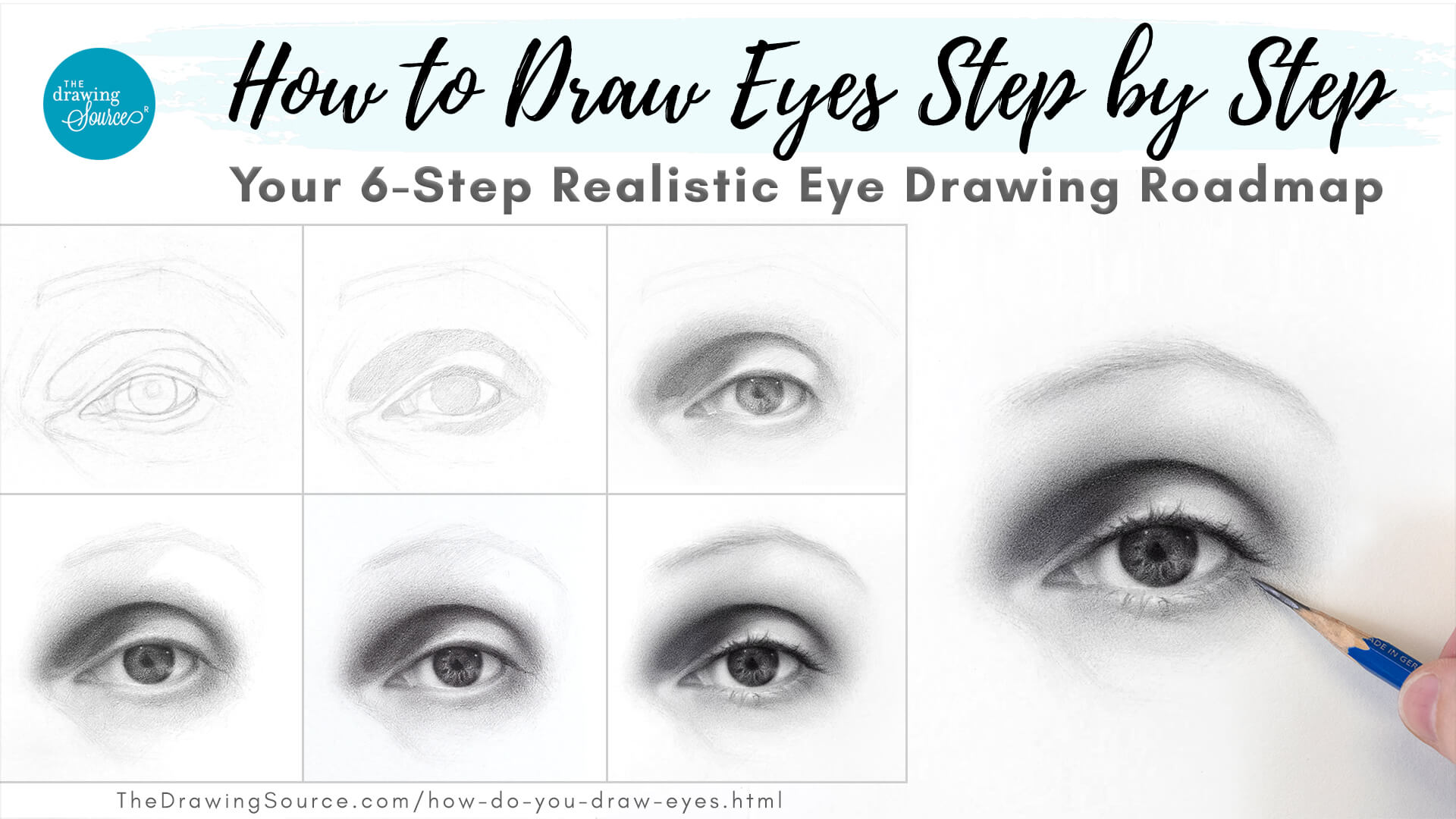
If you’ve ever tried to draw eyes step by step and felt overwhelmed — unsure where to start, what to focus on first, or what the steps even are — this eye drawing tutorial is for you.
In this eye drawing tutorial video, I’ll walk you through a clear, 6-step process to draw realistic eyes that are expressive and lifelike.
You’ll learn:
✔️ the stages of the eye drawing process
✔️ how they build on each other
✔️ what matters most at each one
Watch the video - How to Draw Eyes Step by Step:
Don't miss this free PDF Guide:
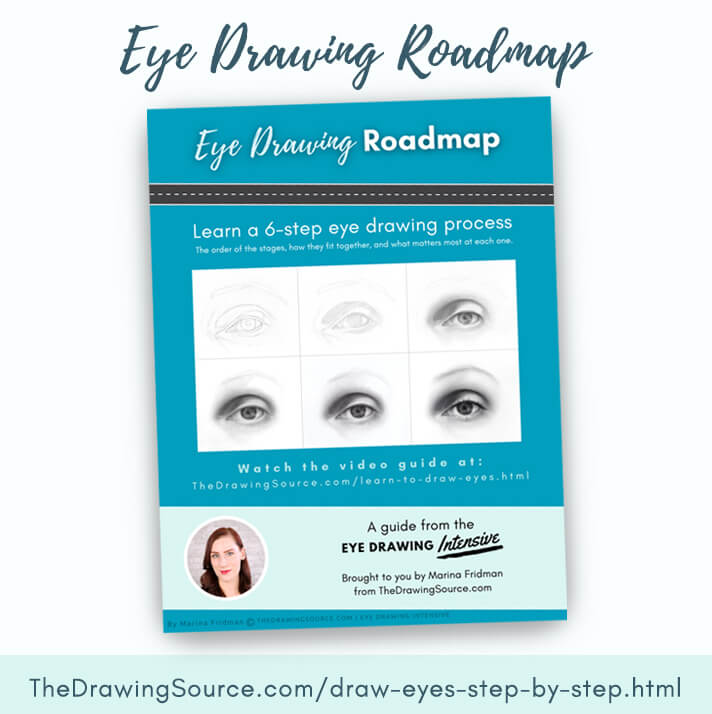
Eye Drawing Roadmap
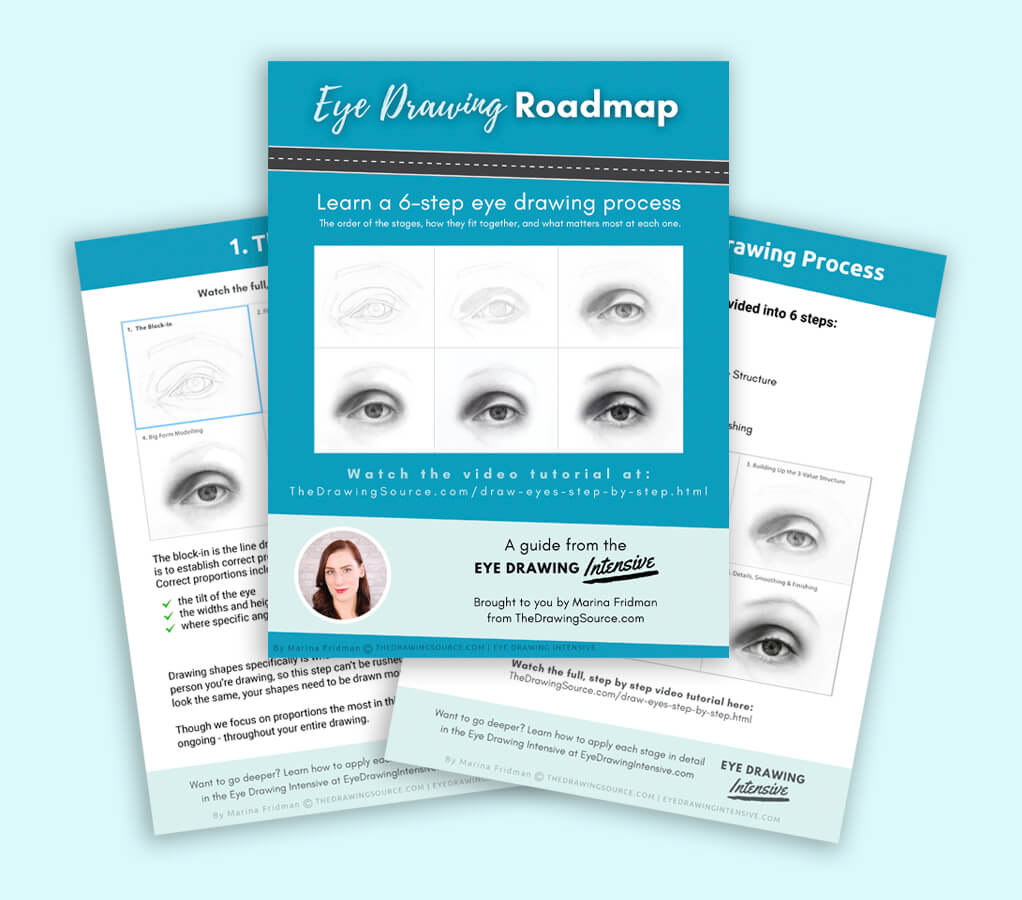
It outlines the 6-step eye drawing process that you'll learn in this video — and includes the description, priorities, and key takeaways for each step. Get the free Roadmap here!
A F T E R T H I S L E S S O N:
Don't miss these eye drawing resources:
- Draw Better Eyes Toolkit!
- Step by Step Realistic Eye Drawing Tutorial
- How to Draw Realistic Eyebrows [Step by Step Tutorial]
- How to Draw Eyelashes [Step by Step Video Tutorial]
- Most Common Eye Drawing Mistakes [Video Series]
Or, transform your eye drawings in my in-depth course:
Prefer to read? Here is the article version of the video!
(... there's more info in the video, though, I recommend it!)
A Quick Introduction
Hi there! I’m Marina – a professional visual artist, former college professor of art, and founder of The Drawing Source. I’ve helped my students create amazing eye drawing
transformations in the Eye Drawing Intensive – my step by step course
on drawing realistic eyes:
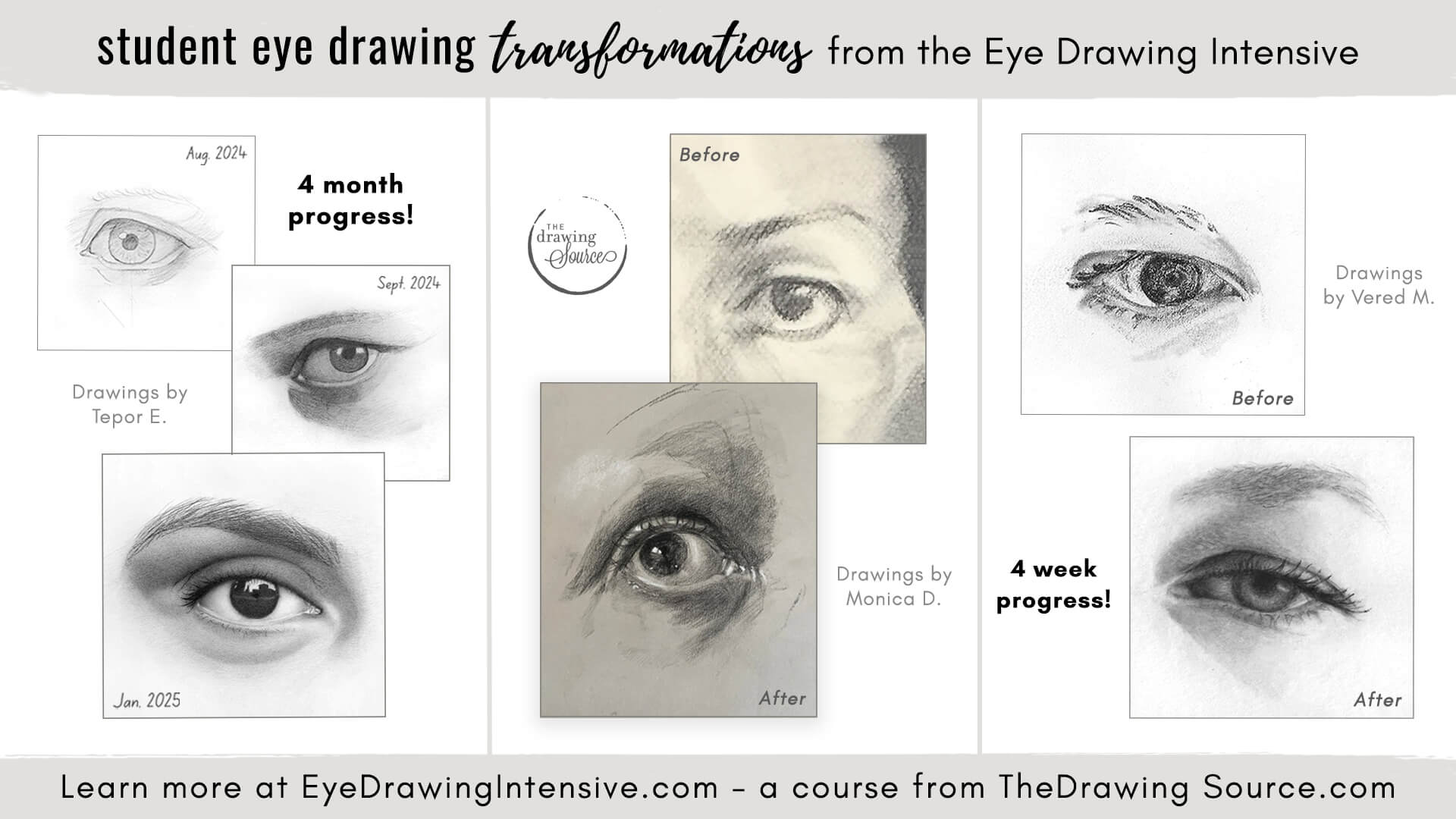
I would love to help you do the
same! To start:
Here are the 6 steps to drawing a realistic eye:
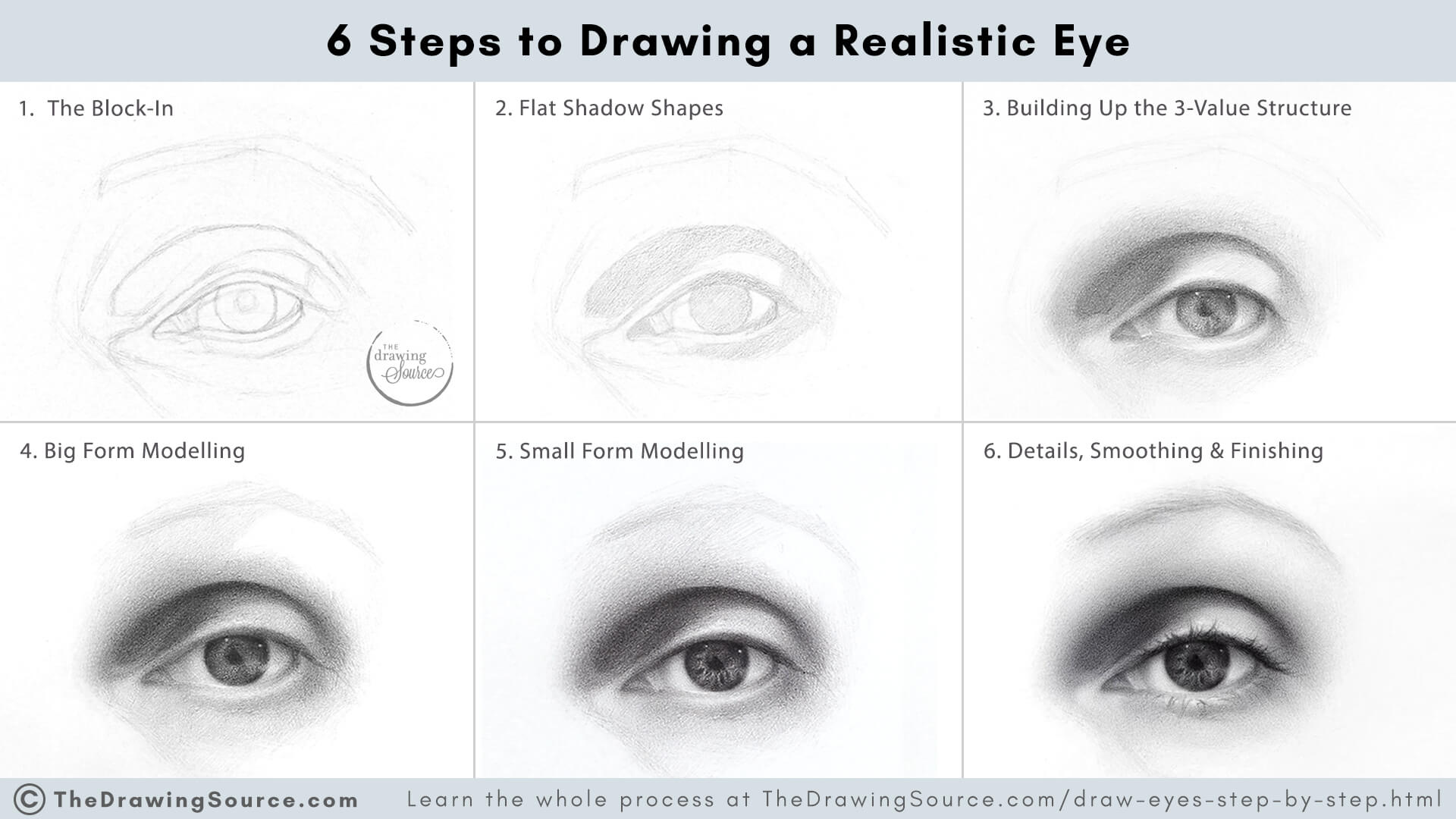
- Block-In
- Flat Shadow Shapes
- Building Up the 3-Value Structure
- Big Form Modelling
- Small Form Modelling
- Details, Smoothing & Finishing
How to Draw Eyes Step by Step
Step 1: The Block-In
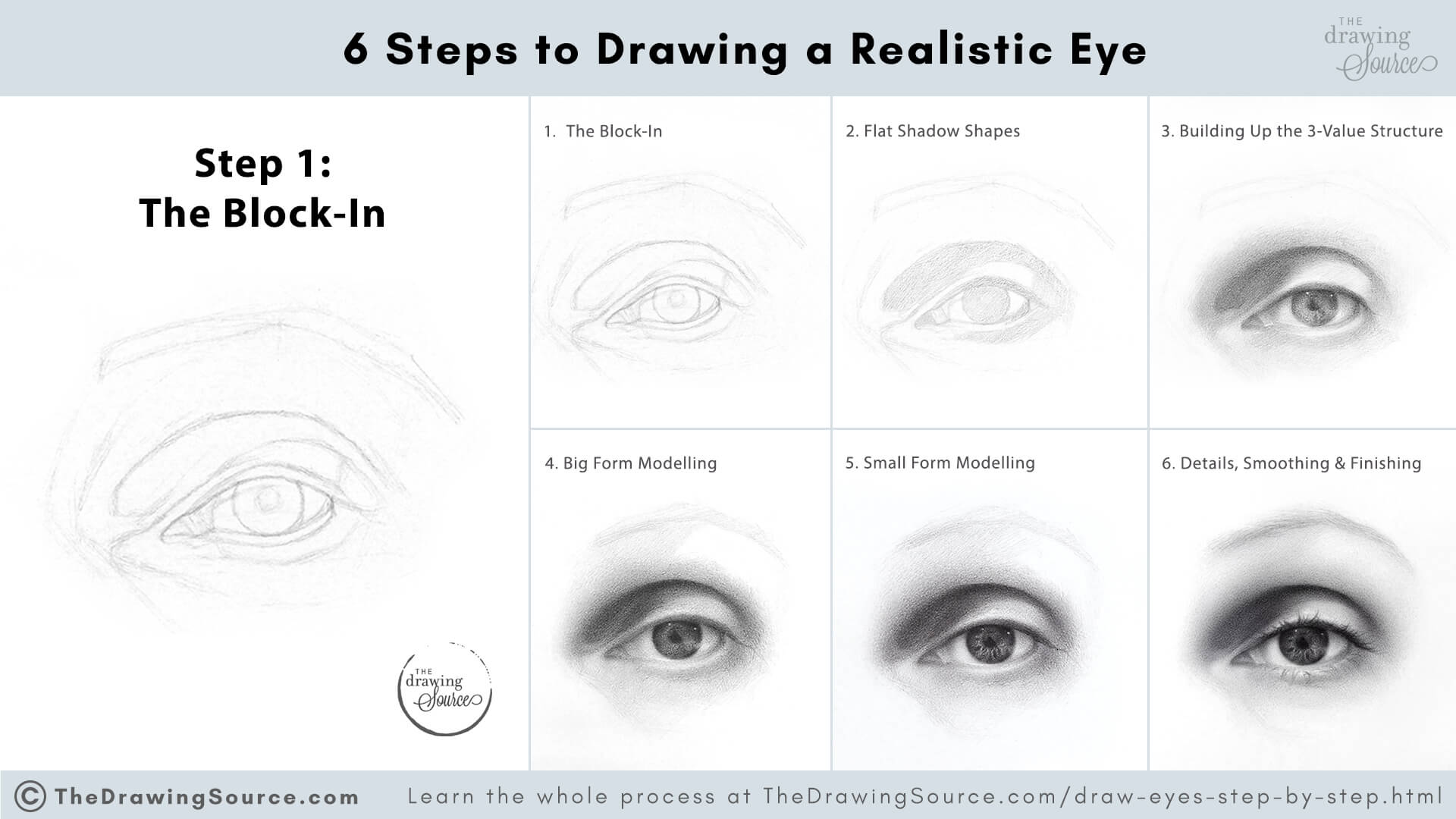
Our first stage is the block-in – this is the line drawing
that will act as a blue-print for shading.
Our priority here is to establish correct proportions and shapes, using line. Correct proportions include:
- the tilt of the eye
- the widths and heights of the eye, and
- where specific angle changes occur
I start by lightly indicating the larger, overall shape of the entire eye, just so I can place it where I want it to be on my page.
But I quickly turn my attention to this angle. Often the first line of my eye drawings is the tilt of this shape.
I subdivide it to start getting a sense of the proportions and where the inner corner of the eye will be, and then I approximately block in this shape – the opening of the eye.
I’m looking for the major angle changes here, and the heights and widths at different spots. Drawing this shape very specifically is what will create a likeness or resemblance to the person you’re drawing, so it really can’t be rushed.
If all your eye drawings tend to look the same, you’re not drawing the shapes specifically enough, because specific shapes create likeness.
Notice that I always work from general to specific. I found the general shape, and once the proportions seem approximately correct, I get more and more specific. Now I can add more information, like the iris of the eye, I can subdivide the inner corner of the eye, and then evaluate the proportions again.
Checking proportions is ongoing, throughout your entire drawing.
Once I’m confident in this shape, I continue to the all-important planes of the eyelids. I talk extensively about the planes of the eyelids in this video - Part 1 of my most common eye drawing mistakes series - so definitely don’t miss that.
To draw an accurate block-in of an eye, we need to know:
- essential eye anatomy, otherwise it’s easy to miss an entire form of the eye
- what to include in our block-in, and
- what to leave out of our block-in
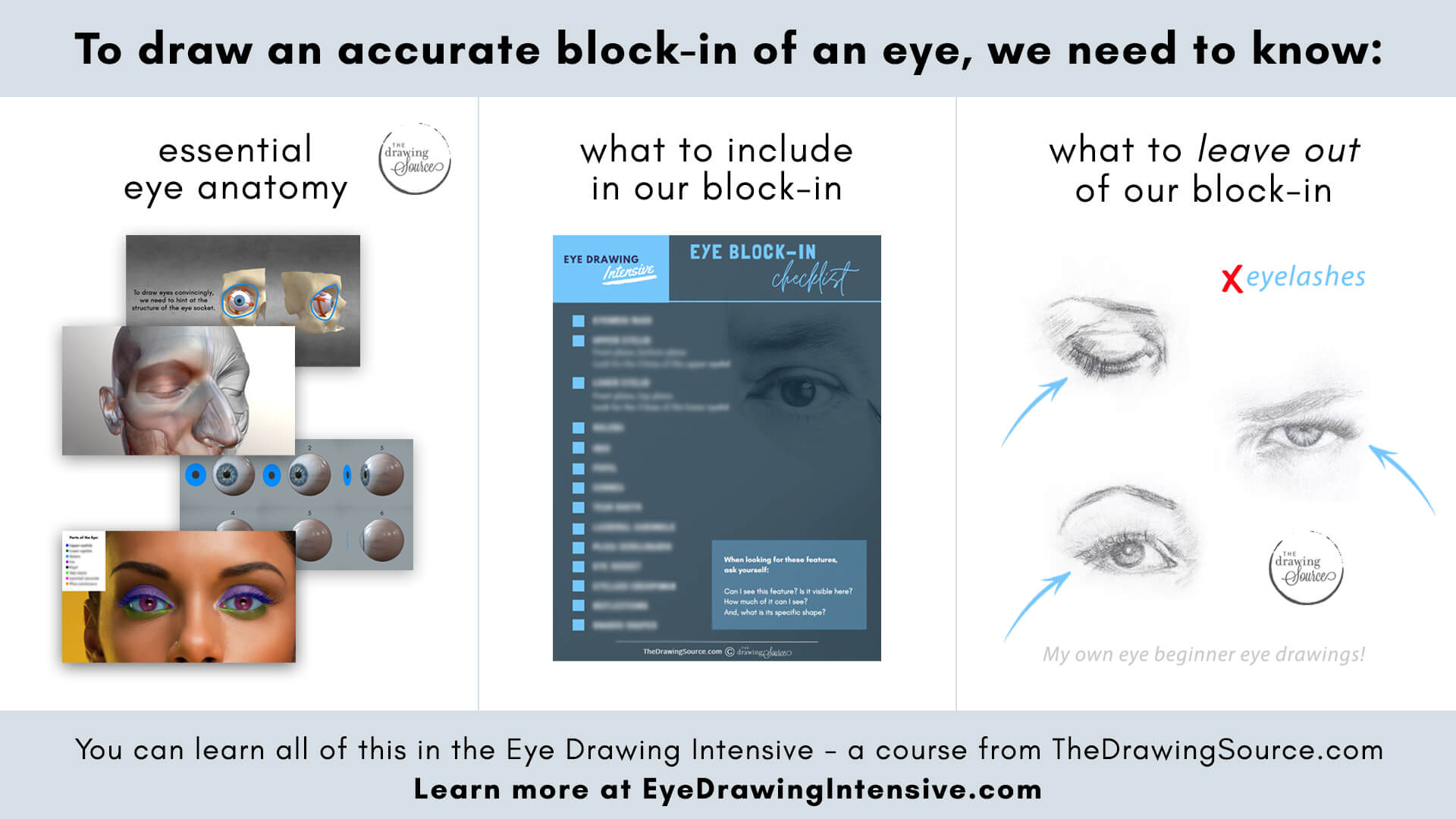
For example, I often see beginners including elements like
eyelashes in this initial eye drawing (like I did in my beginner eye drawings above), and it makes the rest of the drawing
really difficult, because eyelashes obscure other forms that you must draw
first. You’ll notice that in this tutorial drawing, the eyelashes are the last detail
that I draw, like the icing on a cake.
You can learn all of these things in detail, in my Eye Drawing Intensive. Eye anatomy doesn’t have to be intimidating – I’ve simplified it to the absolute essentials you need to know. You’ll be able to rotate 3D models right in the course to really understand each element and to see how the shapes of each element change when viewed from different angles. Learning this will completely change what you see when you observe an eye. And when what we see changes, what we draw transforms, too.
I add the shadow shapes in the sclera to my block-in, and I continue working my way from the center of the eye outwards.
I’ve been using comparative measurement here, but there are many methods of measurement you can use to draw an eye. I present four methods of measurement in my Eye Drawing Intensive, from easiest to most challenging, so that you can choose which one you want to use or practice next.
How to Draw Eyes Step by Step
Step 2: Flat Shadow Shapes
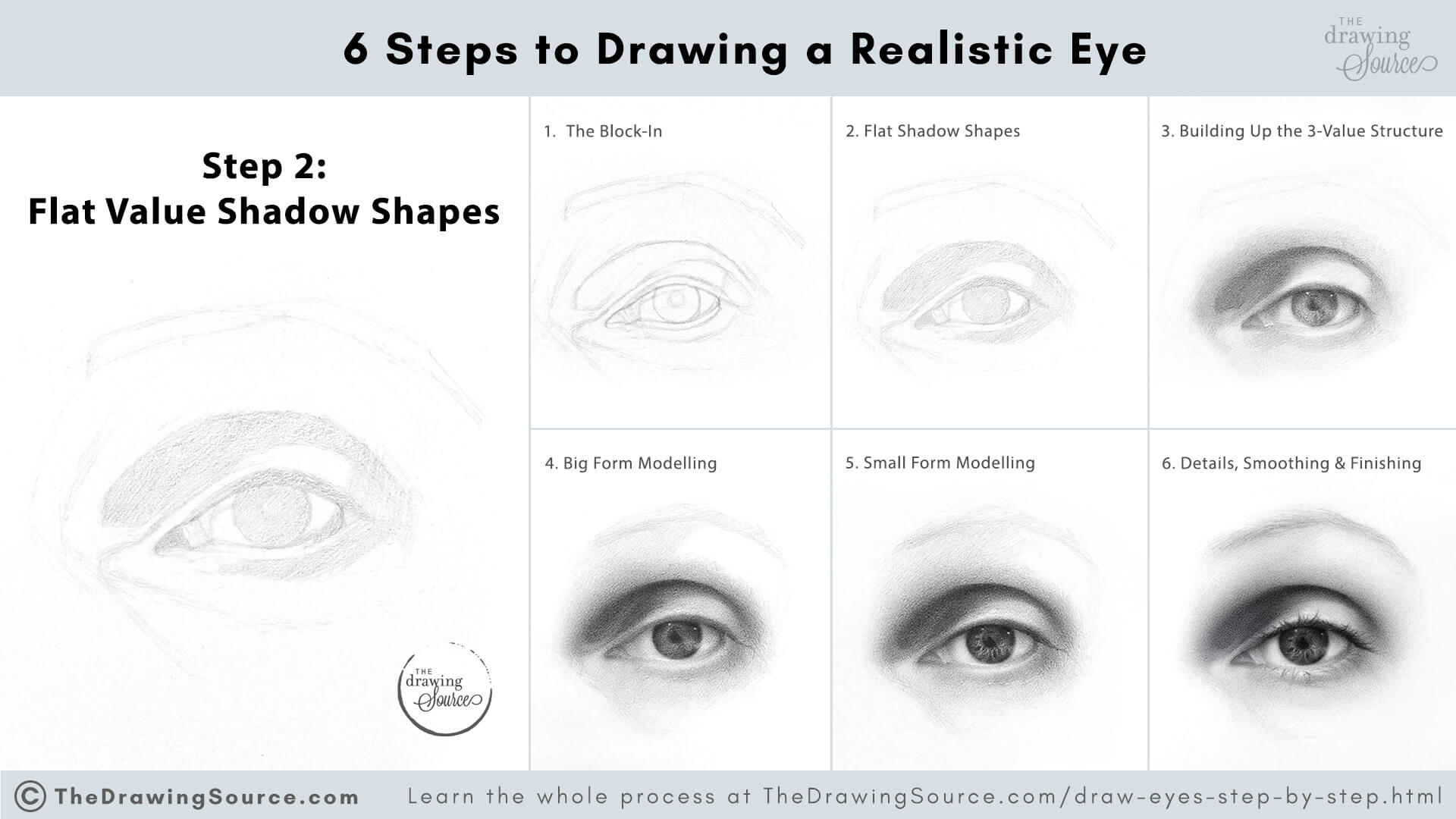
This stage looks like a shading stage, but I don’t really
consider this a shading step.
I am filling in the shadow shapes with a flat, even value, because it makes it easier to check the accuracy of my shapes. So, I consider this a proportion and accuracy step. An in-between step between the block in and shading.
It’s important for the value to be even for this, but it can be fairly light.
Now that the shadow shapes are filled in, I can more clearly see which ones need adjusting, and I use my kneaded eraser to do that. You can learn how to use a kneaded eraser effectively in this video.
How to Draw Eyes Step by Step
Step 3: Building Up the 3-Value Structure
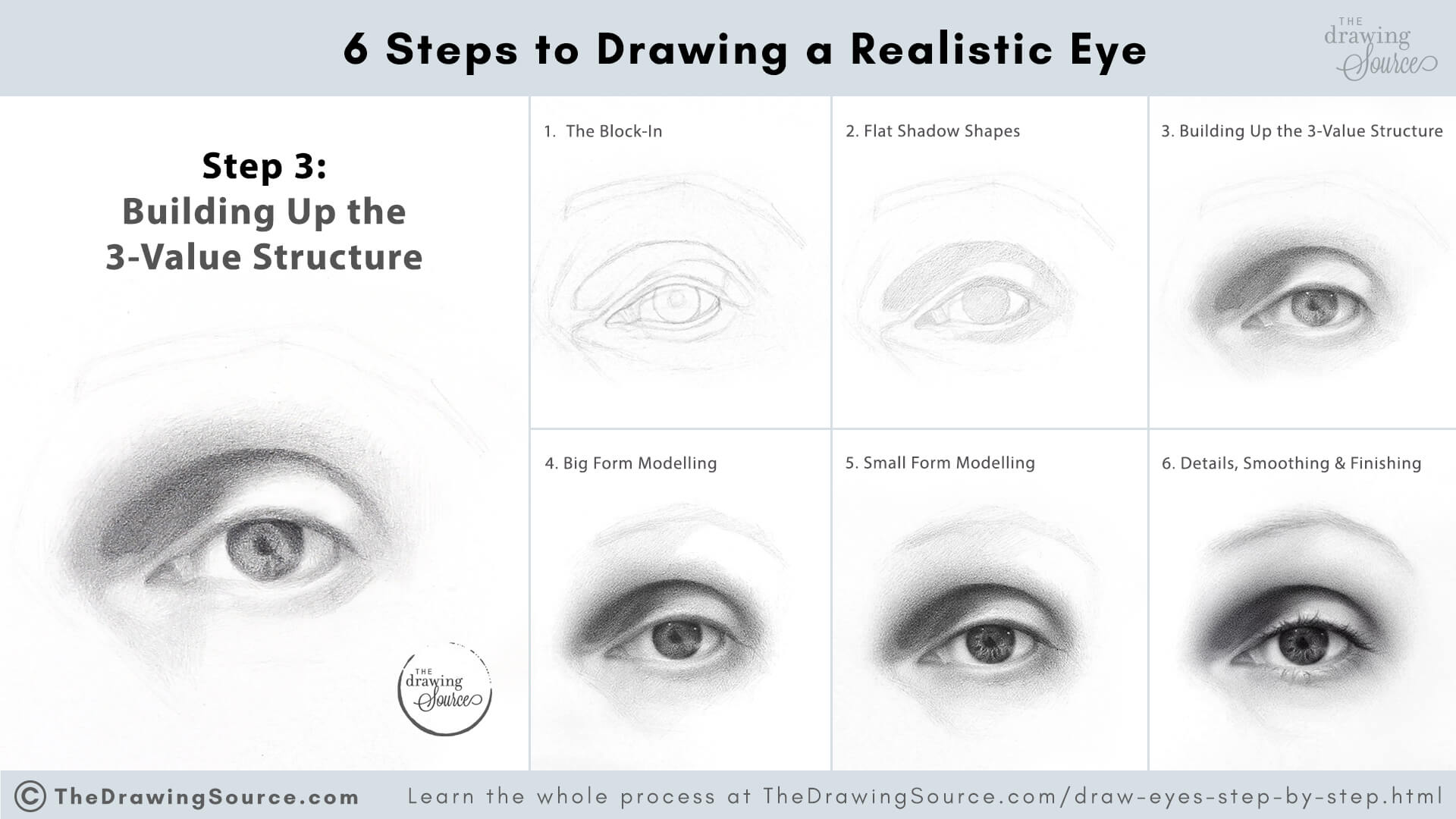
Before we start shading, we must determine the value
structure of our subject. This is the organization of our values: where
will the light, half-tone, and dark values be on our subject? If these value
relationships don’t resemble the value relationships on our subject or
reference, we simply won’t create a realistic, natural-looking drawing.
You can learn and practice drawing three-value studies and creating effective value structures in the Eye Drawing Intensive, but for the purposes of this video: Here is my three-value study for this eye.
Now that I have this, I start building up my values, keeping this 3-value structure in mind. As I darken, my priority is to create a clear separation between the light, half-tone and dark values.
I don’t immediately darken my darkest values because they can be difficult, or even impossible, to erase. I would rather darken them in several passes, which gives me many opportunities to check and re-check my proportions and accuracy, before committing to permanent dark accents.
For example, at this point I noticed that I made the eye socket too big, and
even though I have some decent shading started, I decided to erase and fix my
proportions.
How to Draw Eyes Step by Step
Step 4: Big Form Modelling
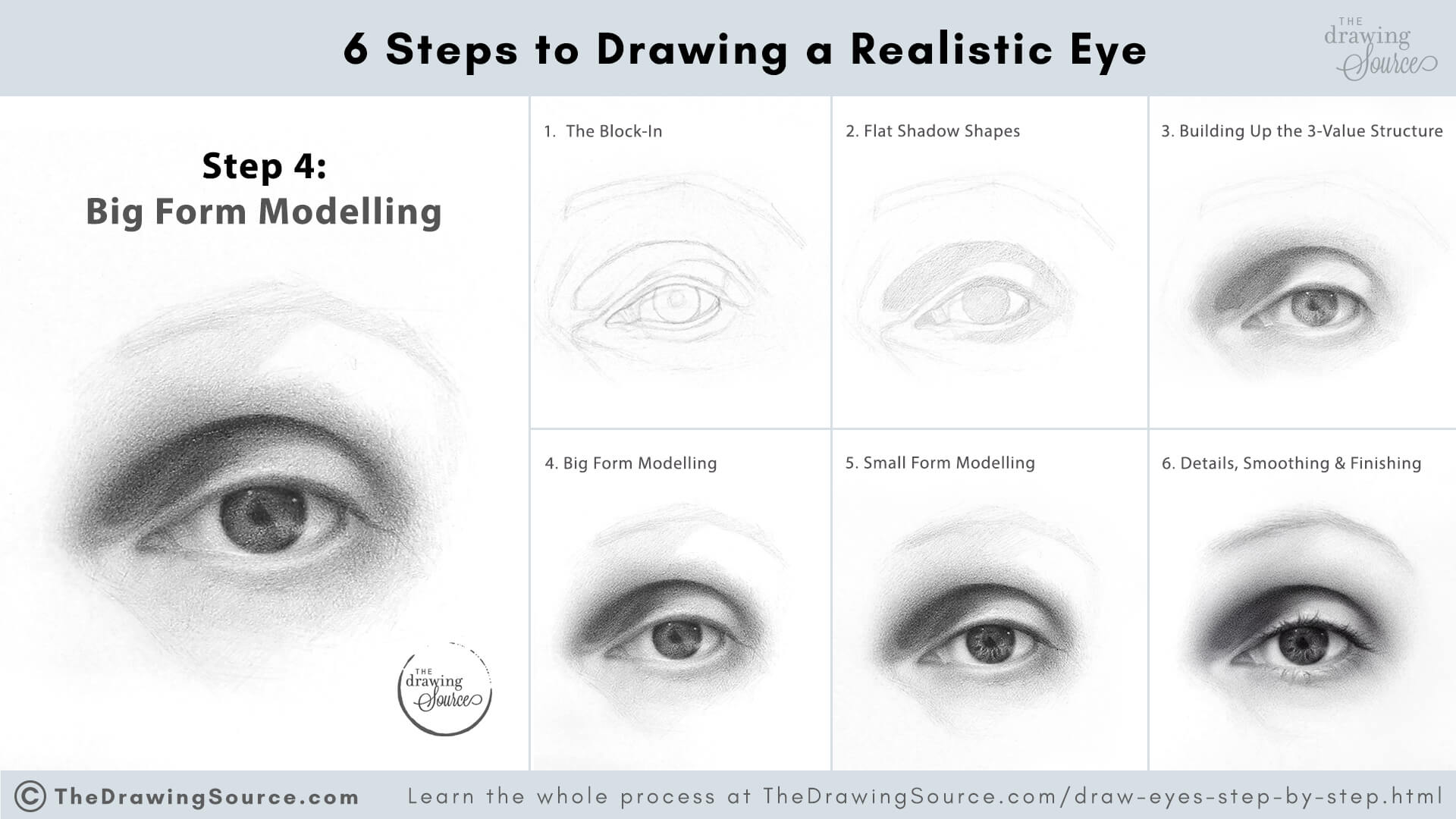
In the big form modelling stage, our priority is to make the larger forms of the eye look convincingly three-dimensional.
This phase is essential because it is not the details that create a 3D illusion. Drawing the larger forms convincingly is what creates a believable sense of depth and dimension.
We need to see through the
detail, model the larger forms first, and then add detail on top.
So, which are the large forms of the eye?

- The Eyeball: We can only see a part of it, but it’s essential that we turn the form of the eyeball so that it reads like the sphere that it is. Notice the gradations and shadows in the sclera - the white of the eye – which is rarely completely white. I go into detail about what to look for and draw in the sclera in this video.
- The Eyelids: the eyelids curve around the eyeball. We need to show that convincingly in our drawing.
- The Eye Socket (and structures surrounding the eye), showing
that the eye rests in the eye socket.
Modelling, or rendering these larger forms convincingly takes an understanding of value relationships, and edges - how to see and draw different edge qualities convincingly. I talk more about drawing convincing edges in eye drawings in this video, and there is a whole module on edges in the Eye Drawing Intensive.
How to Draw Eyes Step by Step
Step 5: Small Form Modelling
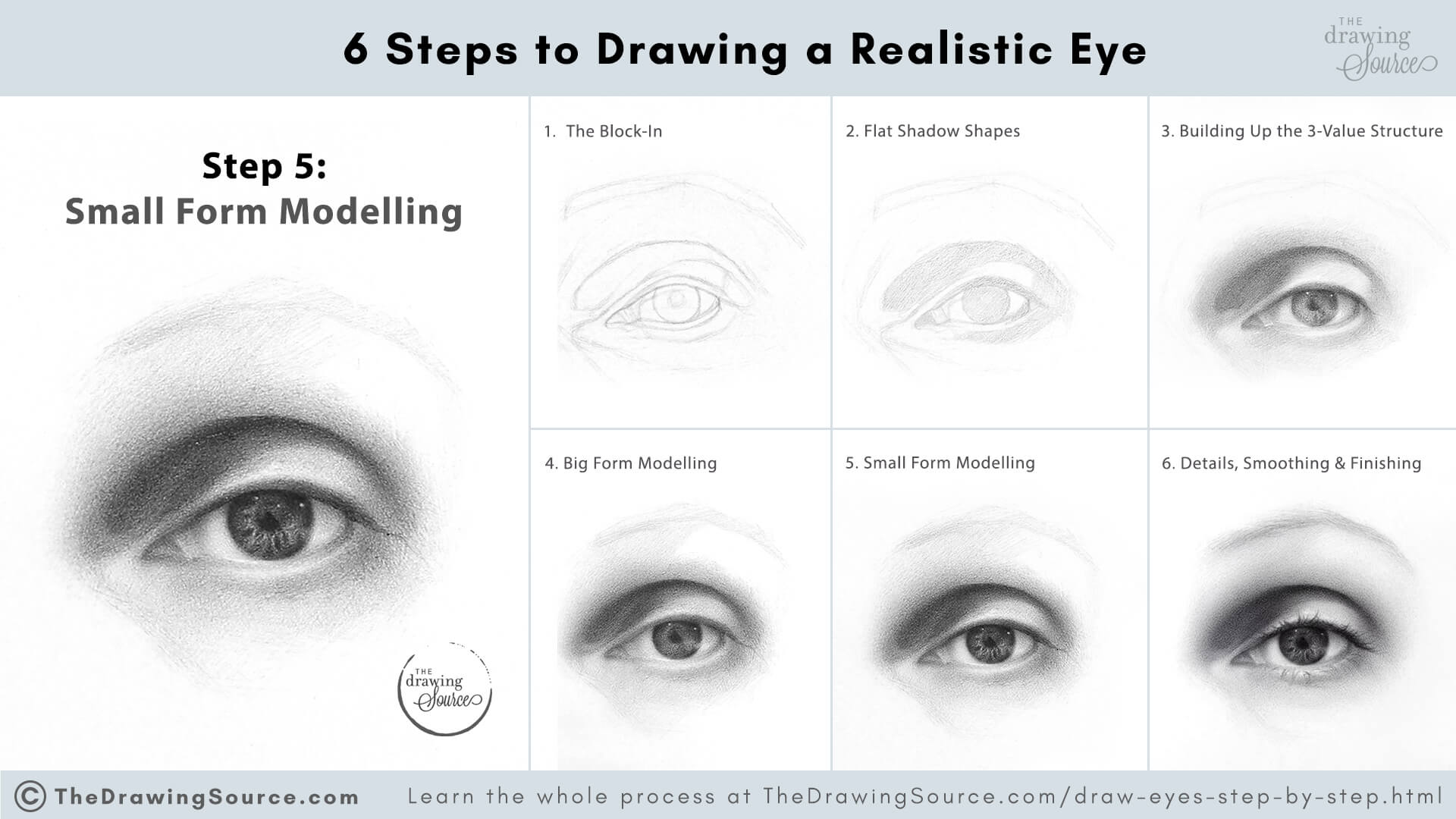
Once the larger forms of the eye are looking convincingly dimensional, our priority becomes modelling (or turning) the small forms - making them look convincingly three-dimensional.
This can include refining the planes of the eyelids, the forms in the inner corner of the eye, and the iris and pupil.
Refining the small forms can include:
- drawing more subtle value shifts, value differences
- drawing more nuanced edges – noticing where there are slightly sharper or slightly softer edges and indicating them in the drawing
- adding more specific highlights
- adding more specific dark accents
For example, in this step I refined the planes of the eyelids by adding clearer highlights and darker accents.
I refined the forms in the inner corner of the eye by sharpening edges and adding more subtle value modulations
I started adding some of the darkest dark values and dark accents to my drawing, now that I’m confident in the proportions and placement of the parts of the eye.
I started adding some detail to the iris and pupil.
How to Draw Eyes Step by Step
Step 6: Details, Smoothing and Finishing the Eye
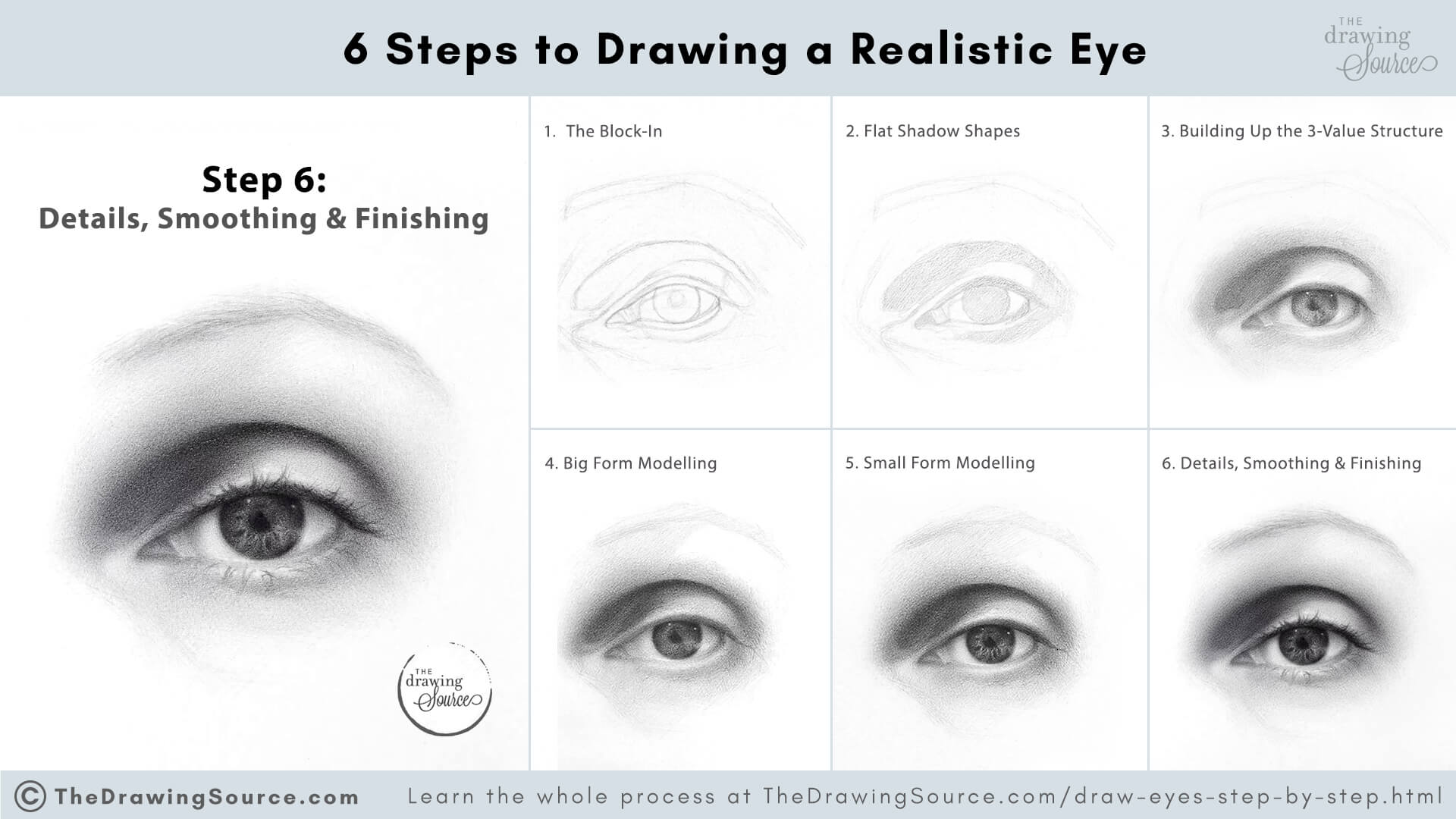
My priorities here are to add any remaining details, and to
smooth out my values and gradations.
Because the eyebrow is so minimal here, I’m just drawing it now, though in other eye drawings where the eyebrow is more prominent, I do address it sooner.
Don’t miss this video, where I discuss a common mistake that results in unrealistic eyebrows, and how to fix it.
This last 10% of the eye drawing can take the most time, because I’m looking more closely than ever at the nuances of each gradation and each form, and recreating them in my drawing.
I finally add the eyelashes – one of my very last steps. I have two detailed video tutorials on drawing eyelashes, so I won’t discuss them here. The links to those videos are in the description box below.
But, can you see that - if I had drawn the eyelashes
earlier, it would have been impossible to draw the planes of the eyelids
underneath, in as much detail as I did? That’s why the eyelashes are a
finishing touch at the end of an eye drawing.
Next steps to learn to draw realistic eyes:
Now you know the 6-step process for drawing realistic eyes -
the priorities of each stage, and how they build on one another!
Next, don’t forget to download your free 6-Step Eye Drawing Guide. It includes a description, the priorities and key takeaways for each drawing stage.
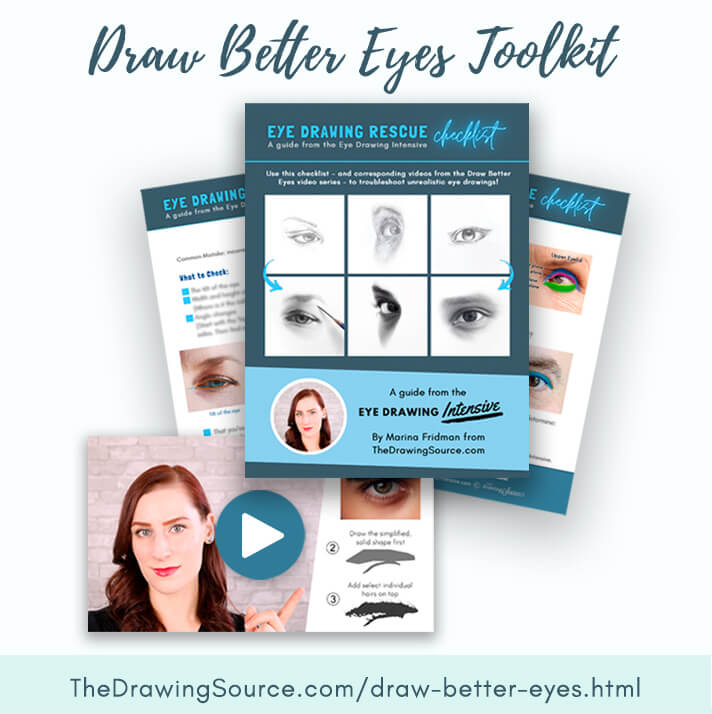
And, get the free Draw Better Eyes Toolkit to help you improve your eye drawings with an Eye Drawing Rescue Checklist and a short video series on how to fix the most common eye drawing mistakes.
When you’re ready to permanently transform your eye drawings, so that you can confidently and consistently draw realistic eyes that not only resemble the person you're drawing, but add expression to your portraits, so that viewers can really connect with your drawing - I invite you to take the Eye Drawing Intensive.
It’s where these students transformed their drawings:
I
would love to help you do the same. You can learn more about the Eye Drawing Intensive here.

Enjoyed this page? Please share it!
If you enjoyed this page on how to draw eyelashes, you may also be interested in ...
Related Pages
Draw Better Eyes - free Toolkit!
How to Draw Realistic Eyes: Step by Step Tutorial
How to Draw Eyelashes Step by Step
How to Draw Eyebrows: Step by Step Tutorial
How to Start a Portrait Drawing
Return from How to Draw Eyes Step by Step to:
Eye Drawing Hub | Portrait Drawing | Drawing Tutorials | Home
Search the site above
Welcome to The Drawing Source!
Here you can learn realistic drawing through six foundational skills that unlock every subject.
Start here if you're new.
Then, explore these learning paths:

Hi, I'm Marina — a professional artist and former professor of art. I started this school to simplify realistic drawing into steps that are easy to understand and apply. Let's grow your skills and your enjoyment of the drawing process.
Realistic Drawing Curriculum
Develop your foundational skills and apply them to figure and portrait drawing in the Atelier membership.
$29/month USD or
$199/year (5 months free)
