- Home
- How to Learn Figure Drawing
- Figure Drawing Gesture
Figure Drawing Gesture vs. Block-In:
The Difference & Why We Need Both
Figure drawing gesture and block-in play different, but complementary, roles.
In this article we'll define gesture drawing and block-in, clarify the difference between the two, and explore why both are essential to a successful figure drawing.
We'll cover:
- What is gesture drawing?
- What is a gesture in figure drawing?
- What gesture is not
- Why gesture drawing is important
- What gesture looks like
- Gesture vs. Block-In definitions
- Why we need both gesture and block-in for successful figure drawings
- Next steps in learning how to draw the figure
This lesson is adapted from Figure Drawing Quickstart: an online course simplifying first steps in figure drawing.
What is gesture in drawing?
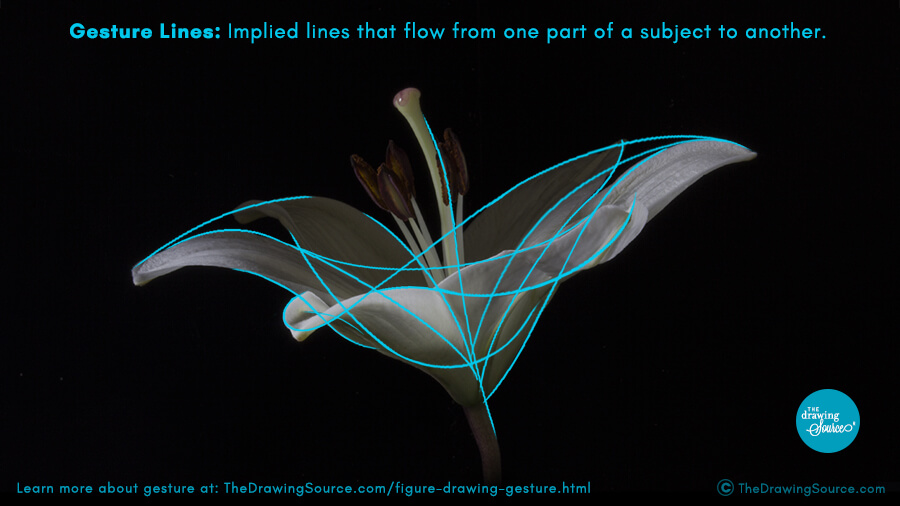
Gesture, or gesture lines, are implied lines that flow from one part of a
subject to another. They create a flowing, underlying structure that connects
all parts of a subject:
What is an 'implied line'?
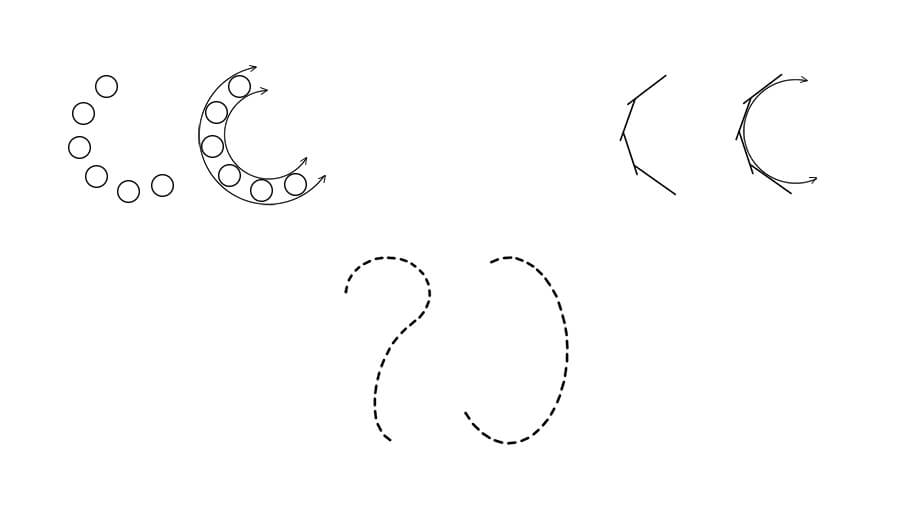
In the diagrams below, the dots aren’t physically connected. They are separate dots and lines. But - we have an innate ability to recognize patterns, so our mind instantly connects the dots and reads them in a sequence, immediately creating relationships between them. The invisible, implied line that connects the dots is the gesture.
Even in the straight lines, we’re able to see the flow that occurs:
 Examples of implied lines
This invisible flow, the gesture, leads our eye through a picture.
If gesture has ever seemed like an elusive drawing concept that’s never explained concretely - it’s because gesture is not always an actual line that exists on our subject. It’s often a subtle, implied line - really more of an idea.
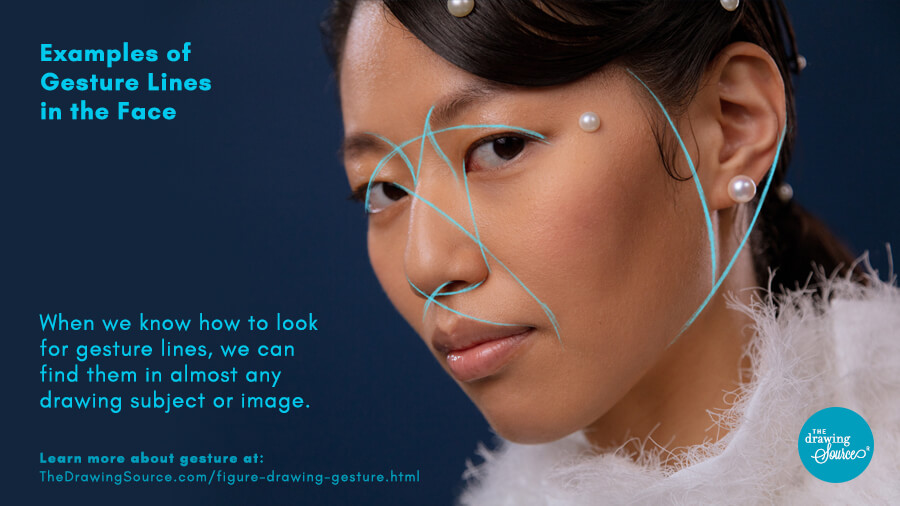
When we know how to look for gesture lines, though, we can find them in almost any drawing subject or image - whether it's a still life, landscape, figure, or portrait.
In my opinion, it’s one of the most
poetic and ethereal concepts in drawing.
 Face gesture drawing
Learn how to see gesture lines, practice drawing them, and discover how to use them as a method of measurement in Bargue Drawing Level 1 (inside Drawing Decoded - soon to be The Atelier at The Drawing Source).
What is a figure drawing gesture?
In figure drawing, gesture ...
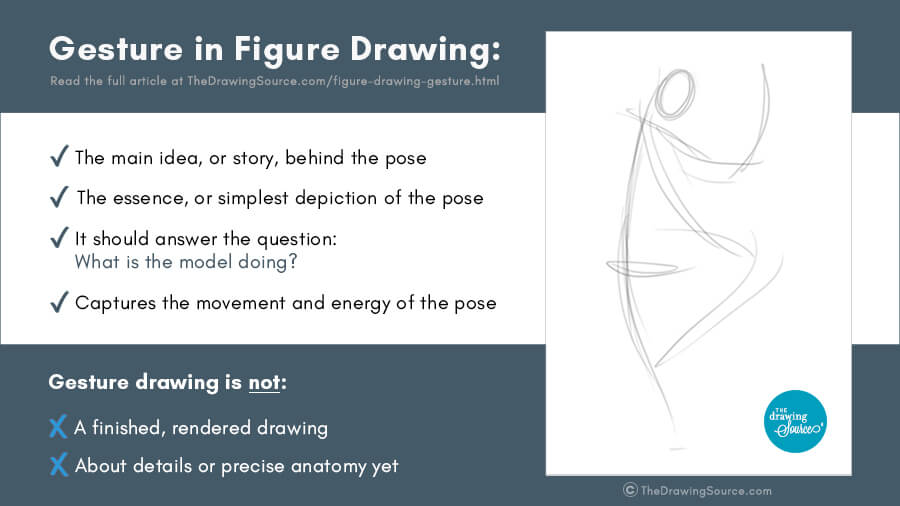
- Is the main idea or story behind a pose
- Is the essence, or simplest depiction of the pose
- Should answer the question: What is the model doing?
- Captures the movement and energy of the pose in a quick, fluid way
What gesture is not:
- A finished, rendered drawing
- About details or precise anatomy yet
Why gesture drawing is important:
- Gesture can add life, movement, and personality to a drawing
- It creates connects separate parts of a subject into a unified whole
- In a figure drawing gesture connects the separate forms of the body in a unified motion. Instead of looking disjointed, it helps our figure drawing look cohesive - like everything naturally fits and flows together.
- Gestures move our eye around an image, creating a dynamic viewing experience
What gesture looks like
A gesture drawing often looks like
a series of flowing c-curve and s-curve lines, made in the first few minutes of
a drawing, that show us what the model is doing.
Different artists, different looks
A gesture can be the starting point for a figure drawing, or it can be a beautiful image on its own.
Some artists love the energy of gesture drawing so much that it becomes their main practice. Some draw gestures loosely and freely, while others treat them as a preparation for the rest of the figure drawing. Because of this, gesture drawings can look very different from one artist to another.
You can explore gesture as both:
- A beautiful, energetic drawing in itself, and/or
- Preparation for the rest of a more detailed figure drawing
We'll explore both in Figure Drawing Quickstart, here.
Figure Drawing Gesture vs. Figure Drawing Block-In
First, let's define gesture and block-in.
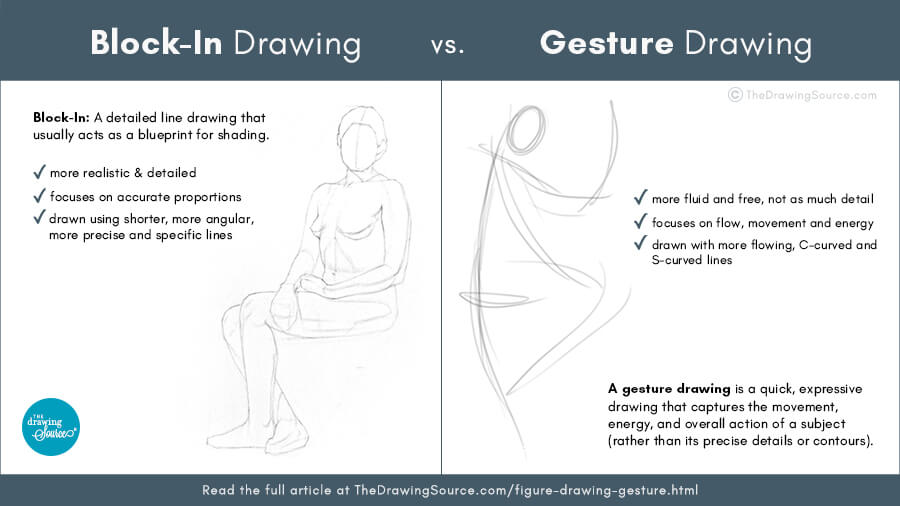
Gesture Drawing Definition: A gesture drawing is a quick, expressive drawing that captures the movement, energy and overall action of a subject (rather than its precise details, forms and contours).
Figure Drawing Block-In Definition: A block-in is a detailed line
drawing that’s used as a blueprint for shading. It helps us establish structure, proportion, and placement, for the rest of the drawing to be built on.
When we think of a block-in vs.
a gesture...
Typically a block-in:
- Is more realistic and detailed
- Focuses on accurate proportions
- Is drawn using shorter, more angular, more precise and specific lines
While a gesture:
- Is more fluid and free, with less detail
- Focuses on the flow, movement and energy of a pose rather than accuracy
- Is drawn with more flowing, C-curved and S-curved lines
Why we need both: a combination of gesture and block-in
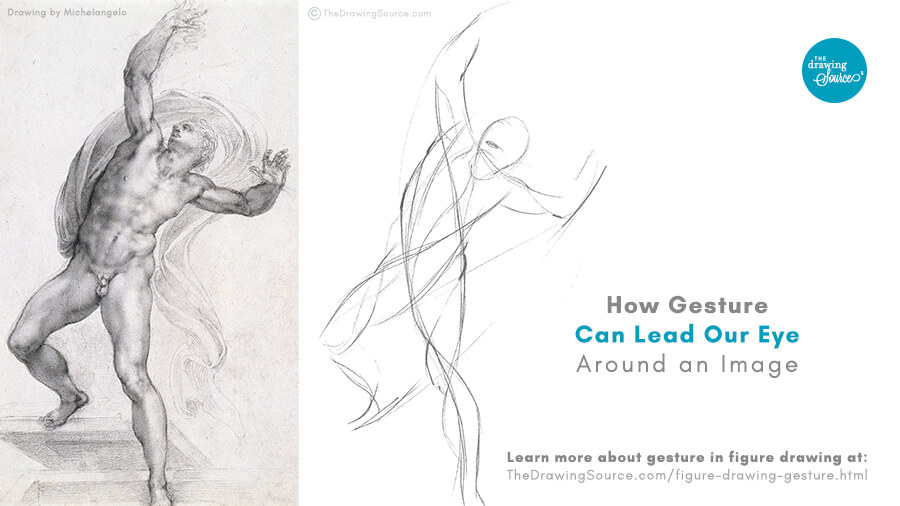
As we'll cover in-depth in Module 4 of Figure Drawing Quickstart, we can use gesture to make sure that every line
in our block in visually leads to another line. This makes our drawing feel
cohesive, instead of disjointed, it creates energy and a sense of life in our
drawing, and it moves our eye through the image:
What happens if we only have one of the two? Only gesture, or only block-in?
- Without gesture, our block in can look stiff, lifeless, and disjointed.
- Without the proportions and accuracy of a block in, we simply won't get a very detailed or realistic figure drawing.
We need both because together we get the best of both worlds. Realism, infused with energy and life.
In Figure Drawing Quickstart, we're going to start our figure drawings with what I call a 'gestural block-in', which
has elements of both. Our goal is a balance of
movement and accuracy, so the drawing feels both alive yet realistic and believable.
Our gestural block-in will become a framework for the rest of our figure
drawing. When
it’s drawn correctly (and we’ll talk about what the means in the course), from that gestural block-in it’s much
easier to add construction, anatomy, shading, and detail.
Next Steps
To achieve a drawing that feels both structurally solid and alive, gesture and block-in need to work together.
But to combine them successfully, we first need to practice them separately:
- Drawing measured figures with accurate proportions, and
- Fluid, energetic gesture drawings
In Figure Drawing Quickstart, I guide students through this process step by step - first developing gesture and block-in separately, and then integrating them into a figure drawing framework that you can adapt to any pose.
Learn more about Figure Drawing Quickstart here.
You may also be interested in:
Figure Drawing Quickstart: Online Figure Drawing Course
7 Figure Drawing Proportions to Know
5 Ways to Start a Figure Drawing
Return to Figure Drawing from Figure Drawing Gesture vs. Block-In
Return to the Homepage from Figure Drawing Gesture vs. Block-In
Search the site above
Welcome to The Drawing Source!
Here you can learn realistic drawing through six foundational skills that unlock every subject.
Start here if you're new.
Then, explore these learning paths:

Hi, I'm Marina — a professional artist and former professor of art. I started this school to simplify realistic drawing into steps that are easy to understand and apply. Let's grow your skills and your enjoyment of the drawing process.
Realistic Drawing Curriculum
Develop your foundational skills and apply them to figure and portrait drawing in the Atelier membership.
$29/month USD or
$199/year (5 months free)
