- Home
- How to Learn Figure Drawing
- Figure Drawing Proportions
7 Figure Drawing Proportions to Know
A universal challenge artists face is depicting accurate figure drawing proportions. If this has been difficult for you, you're not alone. It's one of the most common challenges I see when teaching figure drawing - and one of the most solvable. The good news: drawing accurate proportions is a learnable skill.
In this article, we'll cover:
- What proportions are in figure drawing
- 7 figure drawing proportions to know
- Pro's and con's of using proportional systems
- How to use these proportions to improve your figure drawings
- Why proportions should be established early on in a figure drawing
Free Downloadable Infographic:
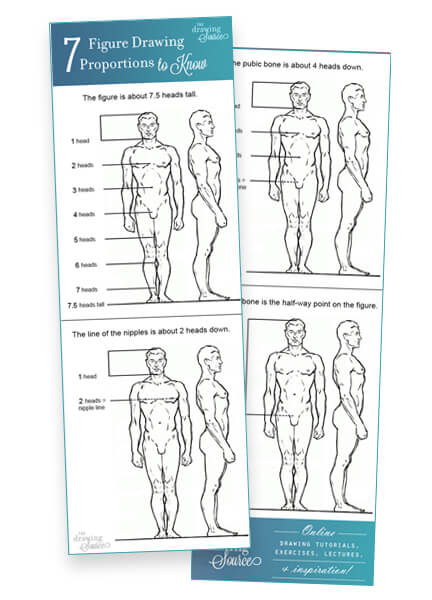
Download a Figure Drawing Proportions Infographic to use as a reminder during your next figure drawing.
Download the free infographic here
What are proportions, and why are they important?
Proportions are the
relationships, or ratios,
between the heights, widths and depths of a subject.
In order to draw a believable likeness of any subject, no matter what or who it is, we must draw the proportional relationships as they appear on that specific subject.
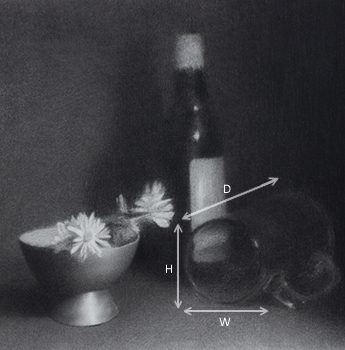
For example, in the drawing to the right, the height and width of the opening of the mug are fairly equal, while the depth is about a width and a half. These are the proportions specific to this mug in this particular scenario.
What would happen if I altered these proportions? The drawn mug wouldn’t quite resemble the mug I was observing, but it could still look believable and convincing.
In the case of a figure or portrait, however, accidentally
altering proportions can create very noticeable distortions. Figure drawing (and portrait drawing) are not forgiving. Minor inaccuracies in figure
drawing proportions decrease the likeness and believability of your drawing, while major
inaccuracies disrupt the logic of the body and cause it to look
anatomically inaccurate
It’s no wonder that artists throughout the ages have tried to standardize these measurements!
It would certainly be convenient to be able
to rely on a memorized proportional system … but can we really rely on one of these systems no matter who we draw? To answer this question, let’s
look at a brief history of proportional canons.
New to figure drawing, and not sure how to start your figure drawings?
Before proportions can help, you need a clear way to start! In Figure Drawing Quickstart, you can learn:
- The 7 essential first elements of a figure drawing
- How to adapt them into the best starting strategy for any pose
- How to measure the figure accurately, and
- How to choose the right measuring technique at the right time
- Learn more about Figure Drawing Quickstart here
Examples of
Proportional Canons
There have been countless attempts to standardize figure drawing proportions and lay down proportional rules to follow when depicting the body.
However, observing how many systems of measuring proportions exist (or “canons” as
they're called) should be our first clue that - proportional systems are open to interpretation, and no single proportional system
can be consistently accurate.
Every canon (system of measuring proportions) is a search for a certain ideal of beauty. However, as the idea of beauty is so subjective, fluid and ever-changing, so have the canons been throughout history.
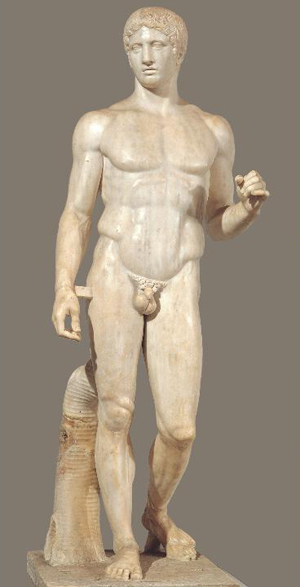
For example, the celebrated Greek canon created by Polycleitus defined a strong, male athlete who excelled at gymnastics and in the handling of weapons.
A typical example of this canon is the Doryphoros, which is one of the best known sculptures of the Classical Era.
However, just as today there are few bodies that fit into current ideas of the “ideal” body, it's likely that few bodies in Polycleitus’ day fit the “ideal” body type of the Doryphoros as well.
 Roman copy of the Doryphoros
Another goal of canons is to establish a unit of
measurement to divide the body into more manageable, measurable
sections that would establish these “ideal” proportions. For example, in the
oldest known text on proportion - an Egyptian canon - the length of the
middle finger was chosen as the unit of measurement. It was thought to be equal
to one nineteenth of the total height of the body.
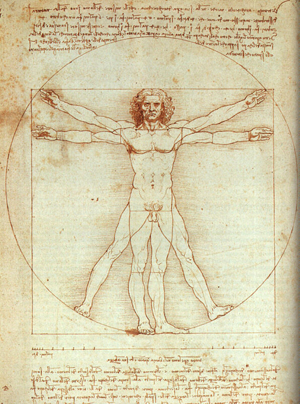 Leonardo da Vinci's Vitruvian Man
In the Greek canon by Polycleitus, the palm of the hand was chosen as the unit of measurement.
Marcus Vitruvius, a first-century BC Roman architect and writer, believed that the height of the figure was eight heads, or ten faces.
Leonardo da Vinci demonstrated many of Vitruvius' ideas on proportion in the well-known image of the man in two superimposed positions inscribed in a square and circle: the "Vitruvian man".
Proportional Canons
of the Present Day
As you may have guessed, the search for a perfect measuring
system is rather pointless. There is so much variation in bodies among individuals that it's impossible for everyone to fit into any set of standards. The
unique qualities of each individual are part of the challenge, complexity and
fascination of drawing the figure. However:
Knowledge of a few general proportions can be helpful to our drawings if we use this knowledge in combination with a sensitive observation of the model.
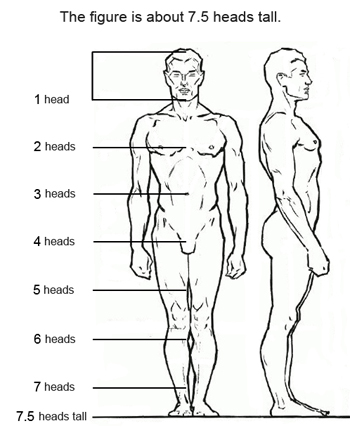
Today the most common unit of measurement is the head of the figure, and the figure is generally thought to be between 7.5 and 8 heads tall. (The head can also be a great place to begin a figure drawing, which you can read about in the 5 Ways to Start a Figure Drawing article.)
What difference does 7.5 and 8 heads make?
The 8 head tall figure will have considerably longer
legs, such as those of a runway model or heroic action figure. A more realistic
figure is approximately 7.5 heads tall, though as I'll continue to point out
throughout this article, these are generalizations and should not be accepted as rules.
An Important Note About Figure Drawing Proportions
Before delving into the figure drawing proportions that are most useful
to remember, please note that:
- These proportions refer to a standing figure.
- As soon as the figure leans toward or away from you, or sits or lies down, measurements become more complicated and will usually no longer fall into the proportions listed below. This is part of the reason figure drawing is such a challenge!
- To learn how to start figure drawings effectively, and how to problem-solve your way through any pose, learn more about the Figure Drawing Quickstart course here.
7 Figure Drawing Proportions to Know
In a standing position, seven figure drawing proportions to keep in mind are:
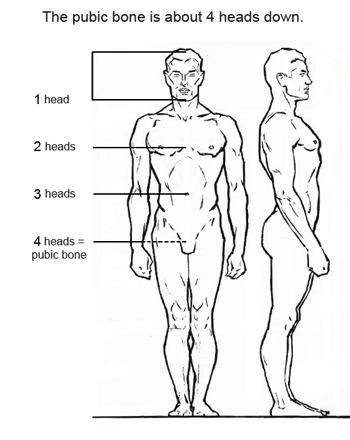
1. The figure is approximately 7.5 heads tall.
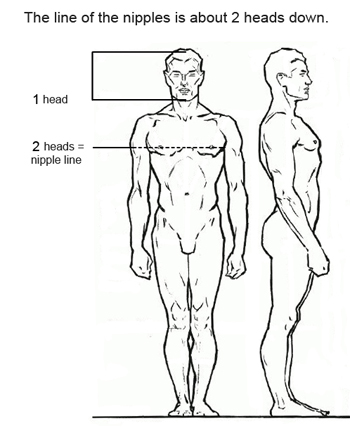
2. About two heads down from the top of the figure is the line of the nipples.
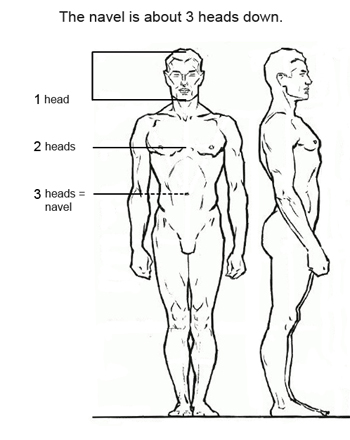
3. About three heads down from the top of the figure is the navel, or belly button.
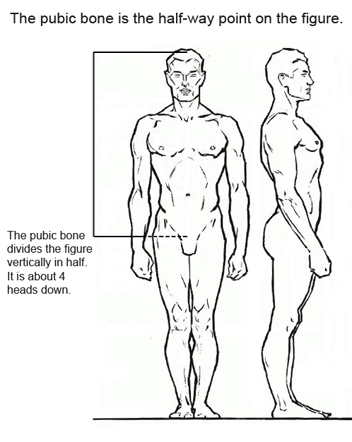
4. About four heads down from the top of the figure is the pubic bone.
5. The pubic bone is approximately the half-way point on the body.
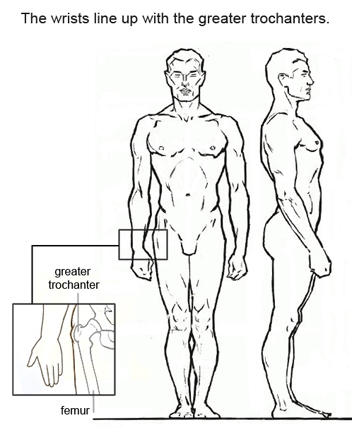
6. The wrists line up with the greater trochanters of the femurs (upper leg bone).
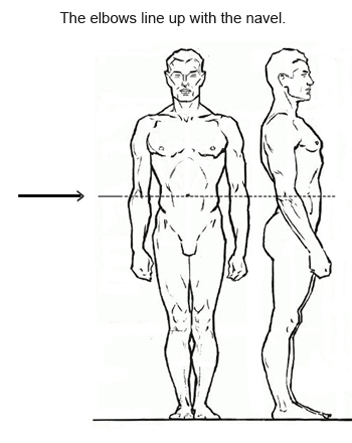
7. The elbows line up with the navel (belly button).
Pros
and Cons of Using Proportional Systems:
We can use these proportions effectively or ineffectively. Here's why:
Cons:
- Relying heavily on memorized proportions can lead to laziness in observing the model, which can result in generic drawings
- Because there is so much variation in body types, no proportional system can be accepted as a “rule”
Pros:
- A proportional system gives you a general reference guide for assessing relative lengths and widths of the body
- Proportions can lead to more accurate and convincing drawings if they are used to compare to the proportions on the model
- Memorizing certain figure drawing proportions can greatly help you draw from memory and imagination
- Memorizing proportions can help you design figures – for example, an animator may intentionally choose to lengthen a figure to 8 or 8.5 heads tall if their intention is to draw a heroic figure.
In my opinion, the greatest benefits are to those designing and drawing figures from memory or imagination. And it's useful for everyone doing any sort of figure drawing, to become more familiar with the body and its proportions, even if they only 'work' in limited scenarios.
How to Use Figure Drawing Proportions Most Effectively
Proportional systems can cause your drawings
to look more generic or more specific - what we want, because specificity creates likeness - depending on how you use them.
How do we achieve greater accuracy with our knowledge of proportions?
This is a key! Instead of assuming that a model will have the exact proportions listed above, use them to check for variations on the figure.
For example, if you know that the navel is usually three heads down from the top of the figure, measure and check to see if this is true on your model (as I do in this step by step figure drawing tutorial).
If it's not - through the process of measuring, you can determine how much higher or lower the navel should be than the three-heads-down point, and then draw it specifically where it appears on the model you're observing.
*You'll be able to learn how to measure the figure in my Figure Drawing Quickstart course here.
It's this heightened observation that will improve your drawings far more than simply memorizing the proportions above.
Why accurate proportions are important to establish early on in a figure drawing
Most strong figure drawings are built in three distinct stages. You can view these drawing stages on my Figure Drawing Quickstart course page here. (Please note: this page includes realistic figure drawings.)
1. The Gestural Block-In
(Different artists use different terms for this - this is the one I use for my figure drawing method.) This is the foundation of our drawing — where we establish movement, proportions, and the overall idea of the pose are established.
2. Construction & Anatomy
Here, we build structure on top of that foundation, clarifying form and understanding what’s happening beneath the surface.
3. Rendering & Refinement
Finally,
we develop the drawing with values, edges, and details. This final,
rendered drawing is only convincing if the first two stages are solid.
If our proportions are incorrect when we get to Rendering and Refinement - no amount of shading will fix our drawing. To learn how to build a strong gestural block-in, with a balance of movement and accurate proportions, learn more about Figure Drawing Quickstart here.
You'll learn:
- A flexible, adaptable framework for starting any figure drawing
- The 7 essential first steps of a successful figure drawing
- How to problem-solve the first few marks, even when they’re not obvious
- How to build a strong gestural block-in that captures movement and proportion
- How to measure the figure accurately to establish correct proportions early on
Continue Learning About Figure Drawing Proportions
I hope you enjoyed this page on figure drawing proportions! To continue learning:
1) Download the figure drawing proportions infographic below.
2) Scroll down to view related figure drawing pages you might be interested in. Or,
3) Dive into my Figure Drawing Quickstart course here.
Happy Drawing!
By Marina Fridman — a professional visual artist, former tenure-track professor of art, and founder of The Drawing Source, where over 1,000 students have taken drawing courses.
Free Downloadable Infographic:
Download a Figure Drawing Proportions Infographic to use as a reminder during your next figure drawing.
Download the free infographic here
If you enjoyed this page on figure drawing proportions, you may also be interested in ...
Related Pages
Figure Drawing Quickstart Course
5 Ways to Start a Figure Drawing
Step by Step Figure Drawing Tutorial
7 Studies to Improve your Figure Drawing
5 Proportions of the Face to Know
Return to How to Learn Figure Drawing from 7 Figure Drawing Proportions to Know
Return to the Homepage from 7 Figure Drawing Proportions to Know
Search the site above
Welcome to The Drawing Source!
This is an online school teaching realistic drawing through six foundational skills that unlock every subject.
Start here if you're new.
Then, explore these learning paths:

Hi, I'm Marina — a professional artist and former professor of art. I started this school to simplify realistic drawing into steps that are easy to understand and apply. Let's grow your skills and your enjoyment of the drawing process.
Realistic Drawing Curriculum
Develop your foundational skills and apply them to figure and portrait drawing in the Atelier membership.
$29/month USD or
$199/year (5 months free)
