- Home
- Drawing Tutorials
- Shading a Sphere
Sphere Drawing Tutorial Part 3:
Shading a Sphere
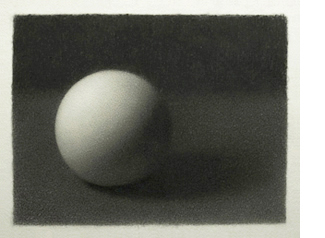
Shading a sphere is one of the most fundamental, useful skills for a representational artist to learn.
Why?
Because when you draw the figure or portrait, you are shading basic forms that are combined in different ways to create the more complex forms of the human body.
If you take the time to practice this exercise and learn the theory behind shading a sphere (such as the elements of form and value drawing), you will have a much easier time applying your skills and knowledge to drawing the figure and portrait.
For now, let's focus on rendering, or shading a sphere - probably the most rewarding stage of
the sphere drawing process, and certainly my personal favorite.
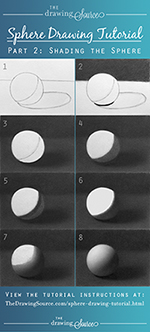
Rendering a Sphere
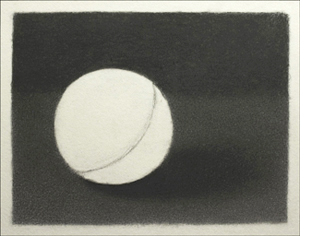
In the previous lesson, (Sphere Drawing Tutorial - Page 2), we worked on creating a realistic environment for the sphere.
Now that the background looks believable, it is time to turn our
attention to drawing the actual sphere, beginning with the form shadow
(the shadow on the sphere itself).
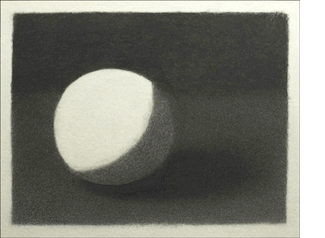
I begin rendering the sphere by filling in a general tone for the form shadow.
I even it out with a bristle brush (link coming soon), being careful not to lose my original drawing.
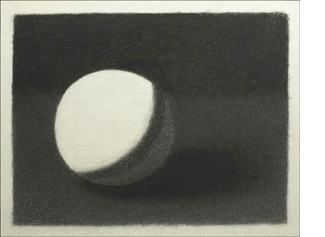
Keep working from dark to light. Determine what the darkest value is on the sphere. In this case, it is the core shadow - the dark band that occurs where light can no longer reach the form.
Once you establish this dark value, you will have a variable to which you can compare the rest of the values on the sphere.
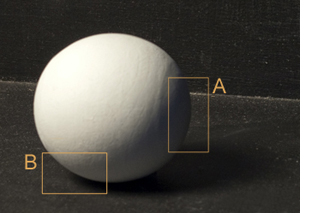
Before you even out the transition between the core shadow and the rest of the form shadow, notice the complexity of this area:
In area A, the form shadow is darker than the background, while in area
B, the form shadow is lighter than the background (due to light
reflecting back into the sphere).
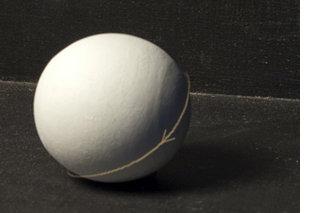
Keep this dark - to - light gradation of the form shadow in mind as you draw it...
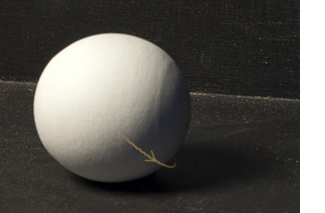
...as well as the gradation from the core shadow to the rest of the form shadow.
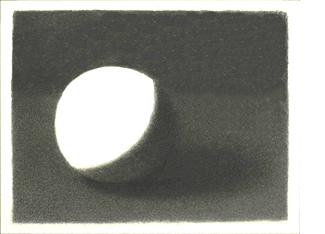
As you continue rendering the sphere, constantly compare the values of the sphere to its surroundings.
Turning the Form of the Sphere
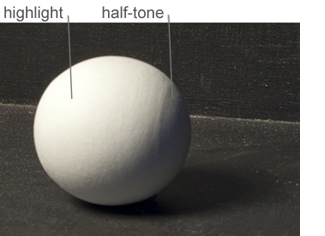
As you begin shading the sphere, remember that you still have values to establish.
The two remaining values are the highlight and the half-tone.
You already have an accurate value for the highlight since you can leave it as the white of the paper.
The challenge is to draw an accurate gradation from the highlight to the half-tone, and from the half-tone to the core shadow.
The gradation must represent the value relationships that you see on the sphere in order to look realistic.
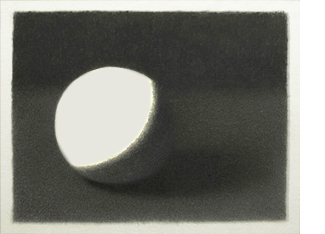
I begin shading the sphere from the core shadow into the half-tone, using a rendering technique called the "airplane stroke".
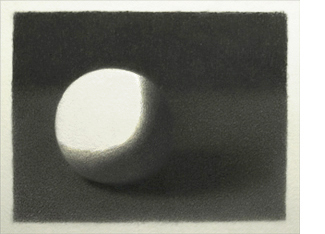
Always keep in mind the form of the sphere.
Pick up your sphere and examine it. Think about how you would sculpt its
smooth surface. Imagine the light running off of the sphere like water.
Do whatever you have to do to become so familiar with the sphere that you almost feel the form turn as you draw your gradation.
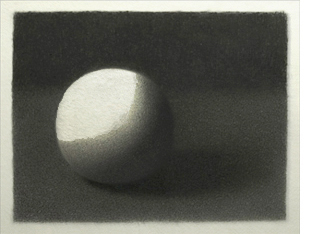
An important note about the half-tone is that it must be lighter than the reflected light on the sphere!
Even if the reflected light looks like it is the same value as the
half-tone, notice how much it darkens and merges with the rest of the
form shadow when you squint.
Drawing it as such will create a much more believable illusion.
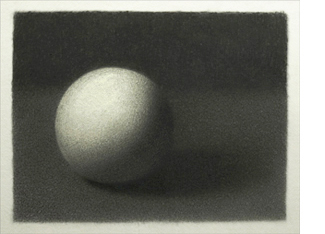
Keep enveloping the form with tone.
Squint at the scene often to check if you are achieving the effect of
light that you are seeing. If your drawn sphere does not have the glow
that you see when you squint at the scene, you are most likely
overmodelling.
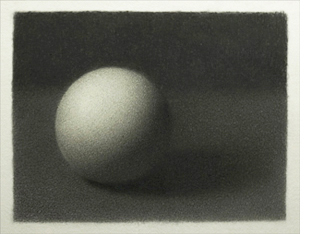
Continue rendering: even out the values by filling in the "gaps" where the charcoal is uneven.
Shading a Sphere: Finishing Touches
Keep adjusting and evening out the values on the sphere. At this point I have lightened the sphere to try to achieve the "glow" that I see when I look at it. I also slightly lightened the reflected light, being careful to still keep it darker than the half-tone.
Finally, I evened out the values so that they mimic the sphere's smooth surface.
To what extent you refine your sphere drawing is completely up to you.
It is a matter of...

Taste: whether aesthetically you like the smooth finish of the drawing above, or the "grainier" look of the one prior to that
Skill: the more knowledgeable you are about the subject you are drawing, and the more comfortable you are with drawing technique and your drawing tools - the further you will be able to take your drawing. You can develop your smooth shading skills in Intro to Smooth Shading in Graphite here.
And patience: this last stage of shading a sphere, the last 10%, can often be the most time consuming!
Let's practice shading a sphere together.
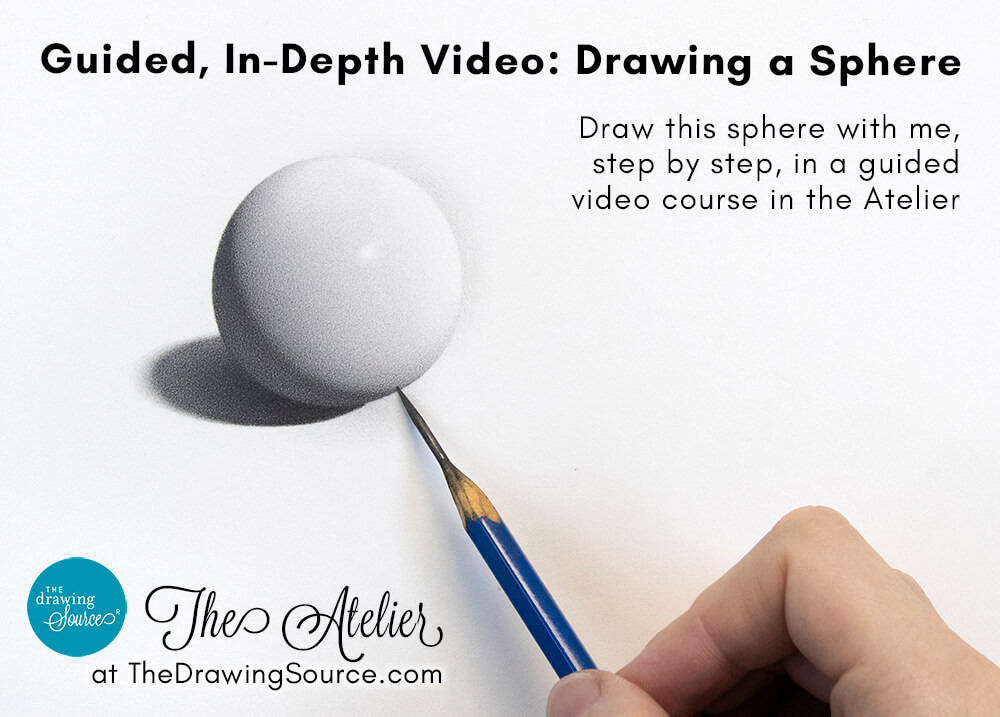
Prefer to follow along with a guided video lesson? In the Atelier at The Drawing Source (formerly Drawing Decoded), I'll walk you through a detailed, step by step tutorial where we'll shade the sphere below using graphite pencils. You'll:
- Download the reference photo
- Follow a clear 6-step drawing process
- Learn how to analyze values and edges in preparation for shading
If you'd like to further strengthen your shading skills, my Intro to Smooth Shading in Graphite course is in the same low-cost membership. Explore The Atelier here.

I hope you enjoyed this foundational exercise!
Next Steps:
1) Download the free infographic on shading a sphere below.
2) Scroll down to explore related value drawing and pencil shading pages.
3) Or, improve your smooth shading skills and draw the sphere above with me, in my foundational drawing program.

Marina Fridman is a professional visual artist, arts educator,
former tenure-track professor of visual art, and Founder of The Drawing
Source.
You may also be interested in these related pages:
Sphere Drawing Tutorial: Page 1
Sphere Drawing Tutorial: Page 2
Value Drawing: A Key to Realism
Return to Sphere Drawing Tutorial: Page 2 from Shading a Sphere
Return to Sphere Drawing Tutorial: Page 1 from Shading a Sphere
Search the site above
Welcome to The Drawing Source!
Here you can learn realistic drawing through six foundational skills that unlock every subject.
Start here if you're new.
Then, explore these learning paths:

Hi, I'm Marina — a professional artist and former professor of art. I started this school to simplify realistic drawing into steps that are easy to understand and apply. Let's grow your skills and your enjoyment of the drawing process.
Realistic Drawing Curriculum

Develop your foundational skills and apply them to figure and portrait drawing in the Atelier membership.
$29/month USD or
$199/year (5 months free)